
Ch. 17 The Cardiovascular System I: The Heart
Amerman - Human Anatomy & Physiology 2nd Edition
Amerman2nd EditionHuman Anatomy & PhysiologyISBN: 9780136873822Not the one you use?Change textbook
Chapter 17, Problem 14

Which chamber generates the highest pressure during systole?
a. Right atrium
b. Right ventricle
c. Left atrium
d. Left ventricle

Verified step by step guidance
1
Understand the concept of systole: Systole refers to the phase of the cardiac cycle during which the heart contracts to pump blood out of the chambers. During this phase, the ventricles generate pressure to push blood into the arteries.
Compare the roles of the heart chambers: The right atrium and left atrium are responsible for receiving blood and do not generate significant pressure during systole. The ventricles, on the other hand, are the main chambers responsible for pumping blood and generating pressure.
Analyze the function of the right ventricle: The right ventricle pumps blood into the pulmonary artery, which leads to the lungs. The pressure generated by the right ventricle is relatively low because the pulmonary circulation is a low-pressure system.
Analyze the function of the left ventricle: The left ventricle pumps blood into the aorta, which supplies oxygenated blood to the entire body. This requires a much higher pressure compared to the right ventricle, as systemic circulation is a high-pressure system.
Conclude based on the pressure requirements: The left ventricle generates the highest pressure during systole because it must overcome the resistance of systemic circulation to deliver blood to all tissues and organs.

Verified video answer for a similar problem:

This video solution was recommended by our tutors as helpful for the problem above.
Was this helpful?

Key Concepts

Here are the essential concepts you must grasp in order to answer the question correctly.

Systole

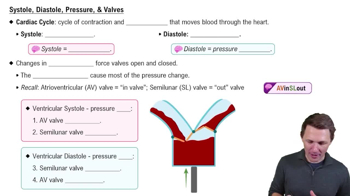
Systole refers to the phase of the cardiac cycle when the heart muscle contracts, pumping blood out of the chambers. During this phase, the ventricles contract to generate the pressure necessary to propel blood into the arteries. Understanding systole is crucial for identifying which chamber of the heart exerts the highest pressure during this contraction.
Recommended video:
Guided course
7:13
Systole, Diastole, Pressure, & Valves

Cardiac Chambers

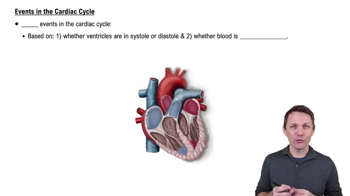
The heart consists of four chambers: the right atrium, right ventricle, left atrium, and left ventricle. Each chamber has a specific role in the circulation of blood. The ventricles, particularly the left ventricle, are responsible for generating the highest pressures to ensure effective blood flow to the lungs and the rest of the body.
Recommended video:
Guided course
9:44
Events in the Cardiac Cycle

Pressure Generation in the Heart

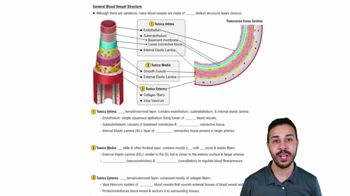
Pressure generation in the heart is primarily associated with the ventricles, especially the left ventricle, which must overcome systemic vascular resistance to deliver oxygenated blood throughout the body. The right ventricle generates lower pressure as it pumps blood to the lungs. Understanding the differences in pressure generation among the chambers is essential for answering questions about cardiac function.
Recommended video:
14:36
General Blood Vessel Structure
Related Practice
Textbook Question

Mark the following statements as true or false. If a statement is false, correct it to make a true statement.

Atrial systole is responsible for ejecting most of the blood into the ventricles during the ventricular filling phase of the cardiac cycle.

978
views
Textbook Question

Mark the following statements as true or false. If a statement is false, correct it to make a true statement.

The amount of blood in the ventricles at the end of the ventricular filling phase is the end-systolic volume.

773
views
Textbook Question

Mark the following statements as true or false. If a statement is false, correct it to make a true statement.

Tissue perfusion to the heart decreases during systole and increases during diastole.

803
views
Textbook Question

Mark the following statements as true or false. If a statement is false, correct it to make a true statement.

The ventricular ejection phase generally correlates with the S-T segment and the T wave on the ECG.

878
views
Textbook Question

The first heart sound is called ________ and it is caused by the closing of the ________ valves. It occurs at the beginning of the ________ phase of the cardiac cycle. The second heart sound is called ________ and it is caused by the closing of the ________ valves. It occurs at the beginning of the ________ phase of the cardiac cycle.

1169
views
Textbook Question

Cardiac output is equal to:

a. End-diastolic volume minus end-systolic volume.

b. Heart rate multiplied by stroke volume.

c. Stroke volume divided by end-diastolic volume.

d. Heart rate multiplied by preload.

904
views