
Textbook Question
Mark the following statements as true or false. If a statement is false, correct it to make a true statement.
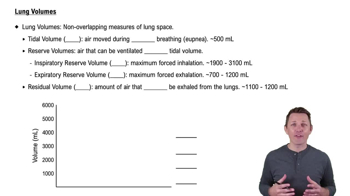
The tidal volume is the amount of air left in the lungs after maximal expiration.
657
views

 Verified step by step guidance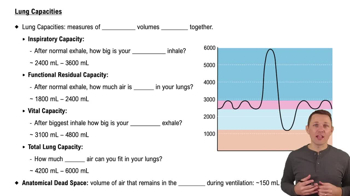
 6:38
6:38
 6:28
6:28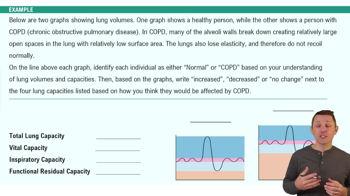 6:18
6:18Mark the following statements as true or false. If a statement is false, correct it to make a true statement.
The tidal volume is the amount of air left in the lungs after maximal expiration.
Which of the following statements about pulmonary ventilation is false?
a. Normal expiration requires the use of the expiratory muscles to decrease lung volume.
b. The inspiratory muscles increase lung volume, which decreases intrapulmonary pressure.
c. For inspiration to occur, intrapulmonary pressure must decrease below atmospheric pressure.
d. The intrapleural pressure is less than the intrapulmonary pressure; this prevents the lungs from collapsing during expiration.
Mark the following statements as true or false. If a statement is false, correct it to make a true statement.
The vital capacity is the total amount of exchangeable air.
Mark the following statements as true or false. If a statement is false, correct it to make a true statement.
The inspiratory capacity is equal to the vital capacity plus the tidal volume.
The function of the epiglottis is to:
a. Contract muscularly to cover the laryngopharynx
b. Vibrate to produce sound
c. Trigger a cough reflex
d. Cover the glottis during swallowing
Match each term with the correct definition.
Airway resistance
Surface tension
Surfactant
Pulmonary compliance
V/Q ratio
a. A detergent-like chemical secreted by bronchial smooth muscle that reduces surface tension
b. The matching of ventilation to perfusion
c. Largely determined by the diameter of the airways
d. Caused by the formation of hydrogen bonds between water molecules
e. Determined by the surface tension of the alveoli, the elastic tissue of the lungs, and the condition of the chest wall