Ch. 15 The Special Senses
Amerman - Human Anatomy & Physiology 2nd Edition
Amerman2nd EditionHuman Anatomy & PhysiologyISBN: 9780136873822Not the one you use?Change textbook
Chapter 15, Problem 11a

Each of the following statements is false. Correct each statement to make it true.
Photons are absorbed by rhodopsin in retinal ganglion cells.

Verified step by step guidance
1
Understand the role of rhodopsin: Rhodopsin is a light-sensitive pigment found in the photoreceptor cells of the retina, specifically in rod cells, not retinal ganglion cells. Rod cells are responsible for vision in dim light.
Clarify the function of retinal ganglion cells: Retinal ganglion cells are neurons that transmit visual information from the retina to the brain via the optic nerve. They do not contain rhodopsin or directly absorb photons.
Correct the statement: Replace 'retinal ganglion cells' with 'rod cells' to accurately describe the location of rhodopsin and its function in photon absorption.
Explain photon absorption: Photons are absorbed by rhodopsin in rod cells, triggering a biochemical cascade known as phototransduction. This process converts light into electrical signals that are sent to the brain.
Summarize the correction: The corrected statement should read, 'Photons are absorbed by rhodopsin in rod cells.' This accurately reflects the anatomy and physiology of the retina.

Verified video answer for a similar problem:

This video solution was recommended by our tutors as helpful for the problem above.
Was this helpful?

Key Concepts

Here are the essential concepts you must grasp in order to answer the question correctly.

Photons and Light Absorption

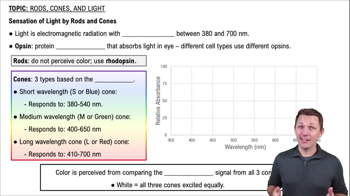
Photons are particles of light that carry energy. In the context of vision, they are absorbed by photoreceptor cells in the retina, specifically by molecules like rhodopsin, which is crucial for converting light into electrical signals. Understanding how photons interact with these molecules is essential for grasping the process of vision.
Recommended video:
Guided course
9:08
Sensation of Light by Rods and Cones

Rhodopsin Function

Rhodopsin is a light-sensitive receptor protein found in the photoreceptor cells of the retina, particularly in rods. It plays a vital role in the phototransduction pathway, where it undergoes a conformational change upon absorbing photons, leading to a cascade of biochemical events that ultimately result in visual perception. Correctly identifying where rhodopsin functions is key to understanding visual processing.
Recommended video:
06:04
Functional Groups

Retinal Ganglion Cells

Retinal ganglion cells are the final output neurons of the retina, transmitting visual information from the photoreceptors to the brain via the optic nerve. They receive input from bipolar cells, which in turn receive signals from photoreceptors like rods and cones. Recognizing the role of these cells helps clarify the pathway of visual information processing and the importance of photoreceptor function.
Recommended video:
05:33
Cell Junctions