Ch. 9 The Muscular System
Amerman - Human Anatomy & Physiology 2nd Edition
Amerman2nd EditionHuman Anatomy & PhysiologyISBN: 9780136873822Not the one you use?Change textbook
Chapter 9, Problem 13b

Mark the following statements as true or false. If the statement is false, correct it to make a true statement.
The latissimus dorsi muscle is a major abductor of the arm

Verified step by step guidance
1
Step 1: Begin by understanding the function of the latissimus dorsi muscle. The latissimus dorsi is a large, flat muscle located in the lower back. Its primary actions include extension, adduction, and medial rotation of the arm at the shoulder joint.
Step 2: Define the term 'abduction.' Abduction refers to the movement of a limb away from the midline of the body. For the arm, this means raising it laterally away from the torso.
Step 3: Compare the actions of the latissimus dorsi with the definition of abduction. The latissimus dorsi is responsible for adduction (bringing the arm closer to the body), which is the opposite of abduction.
Step 4: Evaluate the statement: 'The latissimus dorsi muscle is a major abductor of the arm.' Based on the muscle's function, this statement is false because the latissimus dorsi performs adduction, not abduction.
Step 5: Correct the statement to make it true: 'The latissimus dorsi muscle is a major adductor of the arm.' This accurately reflects the muscle's role in arm movement.

Verified video answer for a similar problem:

This video solution was recommended by our tutors as helpful for the problem above.
Was this helpful?

Key Concepts

Here are the essential concepts you must grasp in order to answer the question correctly.

Latissimus Dorsi Muscle

The latissimus dorsi is a large, flat muscle located in the lower back. It plays a crucial role in various movements of the shoulder, including extension, adduction, and internal rotation of the arm. Understanding its primary functions is essential for accurately assessing statements about its role in arm movement.
Recommended video:
Guided course
2:00
Introduction to Muscles and Muscle Tissue Example 1

Muscle Actions

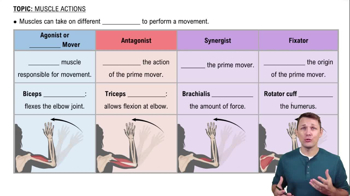
Muscle actions refer to the specific movements that muscles facilitate when they contract. The latissimus dorsi primarily acts as an adductor and extensor of the arm, rather than an abductor. Recognizing the difference between these actions is vital for evaluating the accuracy of statements regarding muscle function.
Recommended video:
Guided course
5:41
Muscle Actions

Abduction vs. Adduction

Abduction is the movement of a limb away from the midline of the body, while adduction is the movement toward the midline. In the context of the arm, muscles like the deltoid are responsible for abduction, whereas the latissimus dorsi contributes to adduction. Clarifying these terms helps in correcting misconceptions about muscle roles.
Recommended video:
05:05
Passive vs. Active Transport
Related Practice
Textbook Question

Mark the following statements as true or false. If the statement is false, correct it to make a true statement.

The rhomboid major and minor muscles retract the scapula.

800
views

Textbook Question

Match the muscle with its main action:

_____Sternocleidomastoid muscle     

_____Transversus abdominis muscle     

_____Internal oblique muscle     

_____Rectus abdominis muscle     

_____Splenius capitis muscle     

_____Quadratus lumborum muscle.

a. Laterally flexes the trunk

b. Flexes the trunk

c. Compresses the abdominal cavity

d. Extends the vertebral column

e. Flexes the head

f. Extends the head

711
views
Textbook Question

Match the muscle with its main action:

______Biceps brachii muscle     

______Pronator teres muscle     

______Extensor digitorum muscle     

______Brachialis muscle     

______Triceps brachii muscle     

______Flexor carpi radialis muscle.

a. Extends fingers and hand

b. Supinates forearm

c. Flexes hand

d. Extends forearm

e. Pronates forearm

f. Flexes forearm

819
views
Textbook Question

Mark the following statements as true or false. If the statement is false, correct it to make a true statement.

The pectoralis major and coracobrachialis muscles are antagonists.

777
views
Textbook Question

Which of the following is not a muscle of the rotator cuff?

a. Teres major muscle

b. Teres minor muscle

c. Subscapularis muscle

d. Infraspinatus muscle

e. Supraspinatus muscle

1238
views
Textbook Question

Mark the following statements as true or false. If the statement is false, correct it to make a true statement.

The deltoid muscle is a main abductor of the forearm.

787
views