Ch. 7 The Skeletal System
Amerman - Human Anatomy & Physiology 2nd Edition
Amerman2nd EditionHuman Anatomy & PhysiologyISBN: 9780136873822Not the one you use?Change textbook
Chapter 7, Problem 4a

Mark the following statements as true or false. If a statement is false, correct it to make a true statement.


a. The four paranasal sinuses are the frontal, parietal, sphenoidal, and mandibular sinuses.

Verified step by step guidance
1
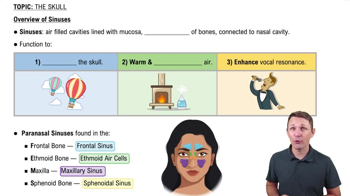
Step 1: Begin by identifying the anatomical structures mentioned in the statement. The paranasal sinuses are air-filled cavities located within certain bones of the skull. Their primary function is to lighten the skull, produce mucus, and enhance voice resonance.
Step 2: Recall the names of the four paranasal sinuses. They are the frontal sinus, maxillary sinus, sphenoidal sinus, and ethmoidal sinus. Compare these names to the ones listed in the statement.
Step 3: Analyze the statement provided. The statement lists the frontal, parietal, sphenoidal, and mandibular sinuses. Note that 'parietal' and 'mandibular' are incorrect because there are no paranasal sinuses associated with the parietal or mandibular bones.
Step 4: Correct the false statement. Replace 'parietal' with 'ethmoidal' and 'mandibular' with 'maxillary' to accurately reflect the names of the four paranasal sinuses.
Step 5: Finalize the corrected statement: 'The four paranasal sinuses are the frontal, ethmoidal, sphenoidal, and maxillary sinuses.'

Verified video answer for a similar problem:

This video solution was recommended by our tutors as helpful for the problem above.
Was this helpful?

Key Concepts

Here are the essential concepts you must grasp in order to answer the question correctly.

Paranasal Sinuses

Paranasal sinuses are air-filled spaces located within the bones of the skull that are connected to the nasal cavity. They include four main pairs: the frontal, maxillary, ethmoid, and sphenoid sinuses. These sinuses play a role in reducing skull weight, producing mucus, and enhancing voice resonance.
Recommended video:
Guided course
3:57
Overview of Sinuses

Anatomical Accuracy

Anatomical accuracy refers to the correct identification and naming of body structures. In the context of the question, it is crucial to recognize that the paranasal sinuses listed in the statement are incorrect, as the parietal and mandibular sinuses do not exist. Understanding the correct anatomical terms is essential for accurate communication in medical and anatomical discussions.
Recommended video:
Guided course
02:40
Anatomical Position

True or False Statements

True or false statements are assertions that can be evaluated for their validity. In this exercise, students must determine the truthfulness of the provided statement about paranasal sinuses. Correcting false statements involves not only identifying inaccuracies but also providing the correct information, which reinforces learning and comprehension of anatomical structures.
Recommended video:
1:46
Structural Class: Synovial Joints Example 3
Related Practice
Textbook Question

Mark the following statements as true or false. If a statement is false, correct it to make a true statement.


c. The sella turcica of the sphenoid bone houses the pituitary gland.

1221
views
Textbook Question

Mark the following statements as true or false. If a statement is false, correct it to make a true statement.


d. The styloid process of the temporal bone is a thick, posterior projection.

927
views
Textbook Question

Predict where each of the following structures is located, based on your knowledge of skeletal anatomy and anatomical terms (your answers should be along the lines of 'lateral crural region' or 'posterior cervical region').


a. Frontal lobe of brain

b. Suprahyoid muscle

c. Ulnar artery

d. Tibial nerve

e. Intercostal muscle

f. External iliac artery

967
views
2
rank
Textbook Question

Ms. Hendrix suffered a severe hip fracture that required hip replacement surgery. After an extended recovery period, she is undergoing physical therapy to regain strength and mobility.

Which bone is involved in a hip fracture, and what part of the bone is likely to be fractured?

781
views
Textbook Question

Mrs. Dent presents to the clinic with back pain. During the exam, you notice that she has severe kyphosis, and you suspect a vertebral fracture. What specific part of her vertebra is likely to be fractured, considering her deformity? Explain.

772
views
Textbook Question

Mark the following statements as true or false. If a statement is false, correct it to make a true statement.


b. The cribriform plate is a component of the ethmoid bone.

912
views