Ch. 20 The Lymphatic System and Immunity
Amerman - Human Anatomy & Physiology 2nd Edition
Amerman2nd EditionHuman Anatomy & PhysiologyISBN: 9780136873822Not the one you use?Change textbook
Chapter 20, Problem 17b

Mark the following statements as true or false. If a statement is false, correct it to make a true statement.
The immune response to a viral infection involves NK cells and different kinds of lymphocytes.

Verified step by step guidance
1
Step 1: Understand the immune response to a viral infection. The immune system uses various components to combat viral infections, including natural killer (NK) cells and lymphocytes such as T cells and B cells.
Step 2: Evaluate the role of NK cells. NK cells are part of the innate immune system and play a crucial role in identifying and destroying virus-infected cells without prior sensitization.
Step 3: Examine the role of lymphocytes. Lymphocytes, including T cells and B cells, are part of the adaptive immune system. T cells help by killing infected cells directly or by activating other immune cells, while B cells produce antibodies to neutralize the virus.
Step 4: Determine if the statement is true or false. Based on the roles of NK cells and lymphocytes, the statement is true because both NK cells and lymphocytes are involved in the immune response to viral infections.
Step 5: If the statement were false, correct it by specifying the roles of NK cells and lymphocytes in the immune response. For example, 'The immune response to a viral infection involves NK cells and lymphocytes such as T cells and B cells.'

Verified video answer for a similar problem:

This video solution was recommended by our tutors as helpful for the problem above.
Was this helpful?

Key Concepts

Here are the essential concepts you must grasp in order to answer the question correctly.

Immune Response

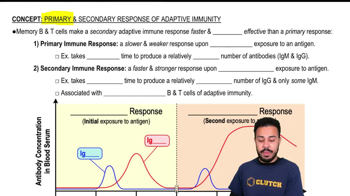
The immune response is the body's defense mechanism against pathogens, including viruses. It involves a complex interplay of various cells and proteins that identify and eliminate foreign invaders. The response can be innate, involving immediate but non-specific defenses, or adaptive, which is slower but provides a targeted attack and memory against specific pathogens.
Recommended video:
6:59
Primary and Secondary Response of Adaptive Immunity

Natural Killer (NK) Cells

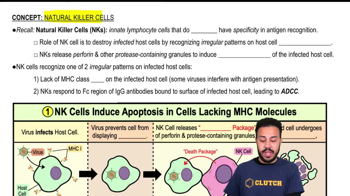
Natural Killer (NK) cells are a type of lymphocyte that play a crucial role in the innate immune response. They are responsible for identifying and destroying infected or cancerous cells without prior sensitization. NK cells recognize stressed cells in the absence of antibodies and MHC, allowing for a rapid immune response to viral infections.
Recommended video:
6:53
Natural Killer Cells

Lymphocytes

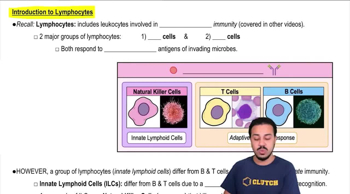
Lymphocytes are a subtype of white blood cells that are essential for the adaptive immune response. They include B cells, which produce antibodies, and T cells, which can directly kill infected cells or help coordinate the immune response. Different types of lymphocytes respond to specific antigens, providing a tailored defense against pathogens.
Recommended video:
3:12
Lymphocytes