
Ch. 2 The Chemistry of Life
Amerman - Human Anatomy & Physiology 2nd Edition
Amerman2nd EditionHuman Anatomy & PhysiologyISBN: 9780136873822Not the one you use?Change textbook
Chapter 2, Problem 3

Which of the following statements correctly describes a solution?
a. In a solution the solute is chemically dissolved by the solvent.
b. Solutions involve large particles suspended in another component.
c. The particles in a solution will settle out if left to sit.
d. The amount of solute in a solution is expressed as the solution's concentration.

Verified step by step guidance
1
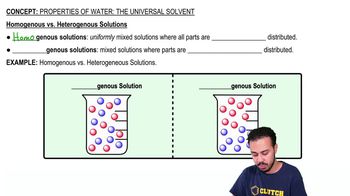
Step 1: Understand the definition of a solution. A solution is a homogeneous mixture where one substance (the solute) is dissolved in another substance (the solvent). The solute is evenly distributed at the molecular level within the solvent.
Step 2: Analyze option a. This statement says that the solute is chemically dissolved by the solvent. This is correct because in a solution, the solute dissolves in the solvent to form a uniform mixture.
Step 3: Analyze option b. This statement mentions large particles suspended in another component. This is incorrect because solutions involve particles that are molecular or ionic in size, not large particles. Large particles are characteristic of suspensions, not solutions.
Step 4: Analyze option c. This statement claims that particles in a solution will settle out if left to sit. This is incorrect because in a true solution, the solute particles do not settle out over time; they remain evenly distributed.
Step 5: Analyze option d. This statement says the amount of solute in a solution is expressed as the solution's concentration. This is correct because concentration is a measure of how much solute is present in a given amount of solvent or solution.

Verified video answer for a similar problem:

This video solution was recommended by our tutors as helpful for the problem above.
Was this helpful?

Key Concepts

Here are the essential concepts you must grasp in order to answer the question correctly.

Solution Definition

A solution is a homogeneous mixture where one substance, the solute, is completely dissolved in another, the solvent. This means that the solute's particles are distributed evenly at the molecular level, resulting in a clear and uniform appearance. For example, when salt is dissolved in water, it forms a solution where the salt ions are dispersed throughout the water.
Recommended video:
02:19
Homogenous vs. Heterogenous Solutions

Concentration

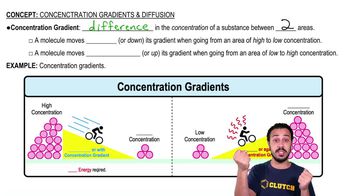
Concentration refers to the amount of solute present in a given volume of solution. It is a crucial concept in chemistry as it quantifies how much solute is dissolved in the solvent, often expressed in units such as molarity (moles per liter) or percentage. Understanding concentration helps in predicting the behavior of solutions in various chemical reactions.
Recommended video:
04:51
Concentration Gradients and Diffusion

Suspension vs. Solution

A suspension is a heterogeneous mixture where large particles are dispersed in a liquid but not dissolved, causing them to settle over time. In contrast, a solution is stable and does not allow particles to settle out, as the solute is fully dissolved. This distinction is important for understanding the properties and behaviors of different types of mixtures in chemistry.
Recommended video:
02:19
Homogenous vs. Heterogenous Solutions
Related Practice
Textbook Question

The drug methotrexate is used to treat several different types of cancer and diseases of the immune system. It works by inhibiting an enzyme in the cell necessary for folic acid synthesis. Without folic acid, the cell cannot make nucleotides. What, specifically, does an enzyme do in the cell? Why would inhibiting this enzyme disrupt folic acid synthesis? What effect would a disruption in folic acid synthesis have on the cell as a whole? (Hint: Think about the role that folic acid plays in the cell.) (Connects to Chapter 2)

798
views
Textbook Question

Considering that water is a main component of the juices in the stomach and intestines, explain why digestion of lipids is more complicated than digestion of carbohydrates and proteins.

674
views
Textbook Question

In certain types of radioactive decay, the isotope releases a particle called an alpha particle, which contains two protons and two neutrons. When this happens, is the product still the same element? Why or why not?

974
views
Textbook Question

Many drugs and poisons exert their effects by blocking one or more enzymes. How could blocking an enzyme lead to the death of a cell?

1054
views
Textbook Question

The polysaccharide cellulose is not digestible by humans, as we lack the enzyme cellulase, which is required to break it down. Certain dietary supplements contain the enzyme cellulase and claim that being able to break down cellulose will help a person lose weight. But what do you think would happen if we could digest the cellulose we ate?

1006
views