Ch. 14 The Autonomous Nervous System and Homeostasis
Amerman - Human Anatomy & Physiology 2nd Edition
Amerman2nd EditionHuman Anatomy & PhysiologyISBN: 9780136873822Not the one you use?Change textbook
Chapter 14, Problem 9c

Mark the following statements as true or false. If a statement is false, correct it to make a true statement.
c. The parasympathetic nervous system releases acetylcholine onto all its synapses.

Verified step by step guidance
1
Step 1: Understand the role of the parasympathetic nervous system (PNS). The PNS is part of the autonomic nervous system responsible for 'rest and digest' functions, such as lowering heart rate and promoting digestion.
Step 2: Recall the neurotransmitter used by the parasympathetic nervous system. The PNS primarily uses acetylcholine (ACh) as its neurotransmitter at both preganglionic and postganglionic synapses.
Step 3: Analyze the statement provided. The statement claims that the parasympathetic nervous system releases acetylcholine onto all its synapses. This is true because acetylcholine is released at both the synapse between the preganglionic and postganglionic neurons, and at the synapse between the postganglionic neuron and the target tissue.
Step 4: If the statement were false, identify the correction. For example, if the statement incorrectly mentioned another neurotransmitter like norepinephrine, the correction would be to specify that acetylcholine is the neurotransmitter used by the parasympathetic nervous system.
Step 5: Confirm the accuracy of the statement based on your understanding of the parasympathetic nervous system and its neurotransmitter usage. In this case, the statement is true and does not require correction.

Verified video answer for a similar problem:

This video solution was recommended by our tutors as helpful for the problem above.
Was this helpful?

Key Concepts

Here are the essential concepts you must grasp in order to answer the question correctly.

Parasympathetic Nervous System

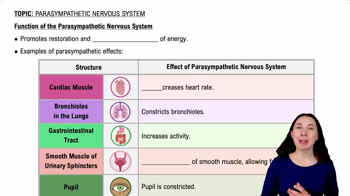
The parasympathetic nervous system is a component of the autonomic nervous system responsible for promoting 'rest and digest' functions. It conserves energy by slowing down the heart rate and increasing intestinal and gland activity. Understanding its role is crucial for evaluating statements about its neurotransmitter actions.
Recommended video:
1:56
Function of the Parasympathetic Nervous System

Acetylcholine

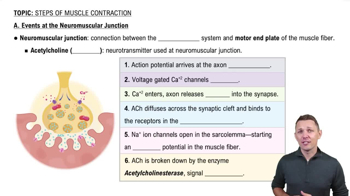
Acetylcholine is a neurotransmitter that plays a key role in transmitting signals in both the central and peripheral nervous systems. In the context of the parasympathetic nervous system, it is primarily released at synapses to facilitate communication between neurons and target organs. Recognizing its specific functions helps clarify the accuracy of statements regarding synaptic transmission.
Recommended video:
Guided course
5:56
A. Events at the Neuromuscular Junction

Synaptic Transmission

Synaptic transmission refers to the process by which neurotransmitters are released from one neuron and bind to receptors on another, allowing for communication between nerve cells. This process is essential for understanding how signals are propagated in the nervous system, including the specific actions of the parasympathetic nervous system and the role of acetylcholine in this context.
Recommended video:
02:52
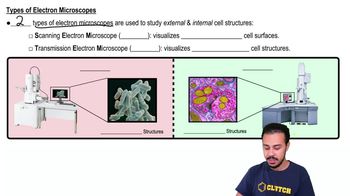
Types of Electron Microscopes