Ch. 4 Histology
Amerman - Human Anatomy & Physiology 2nd Edition
Amerman2nd EditionHuman Anatomy & PhysiologyISBN: 9780136873822Not the one you use?Change textbook
Chapter 4, Problem 5c

Mark the following statements as true or false. If a statement is false, correct it to make a true statement.
Epithelial tissue is highly vascular.

Verified step by step guidance
1
Understand the key term 'epithelial tissue' and its characteristics. Epithelial tissue is a type of tissue that covers body surfaces, lines cavities, and forms glands. One of its defining features is that it lacks blood vessels (avascular).
Analyze the statement: 'Epithelial tissue is highly vascular.' The term 'vascular' refers to the presence of blood vessels. Since epithelial tissue is avascular, this statement is false.
Correct the false statement: Replace 'highly vascular' with 'avascular' to make the statement true. The corrected statement would be: 'Epithelial tissue is avascular.'
Recall how epithelial tissue receives nutrients: Even though it is avascular, epithelial tissue relies on diffusion of nutrients and oxygen from the underlying connective tissue, which is vascularized.
Review the corrected statement and the reasoning behind it to ensure understanding of the concept of avascularity in epithelial tissue and its reliance on nearby tissues for sustenance.

Verified video answer for a similar problem:

This video solution was recommended by our tutors as helpful for the problem above.
Was this helpful?

Key Concepts

Here are the essential concepts you must grasp in order to answer the question correctly.

Epithelial Tissue

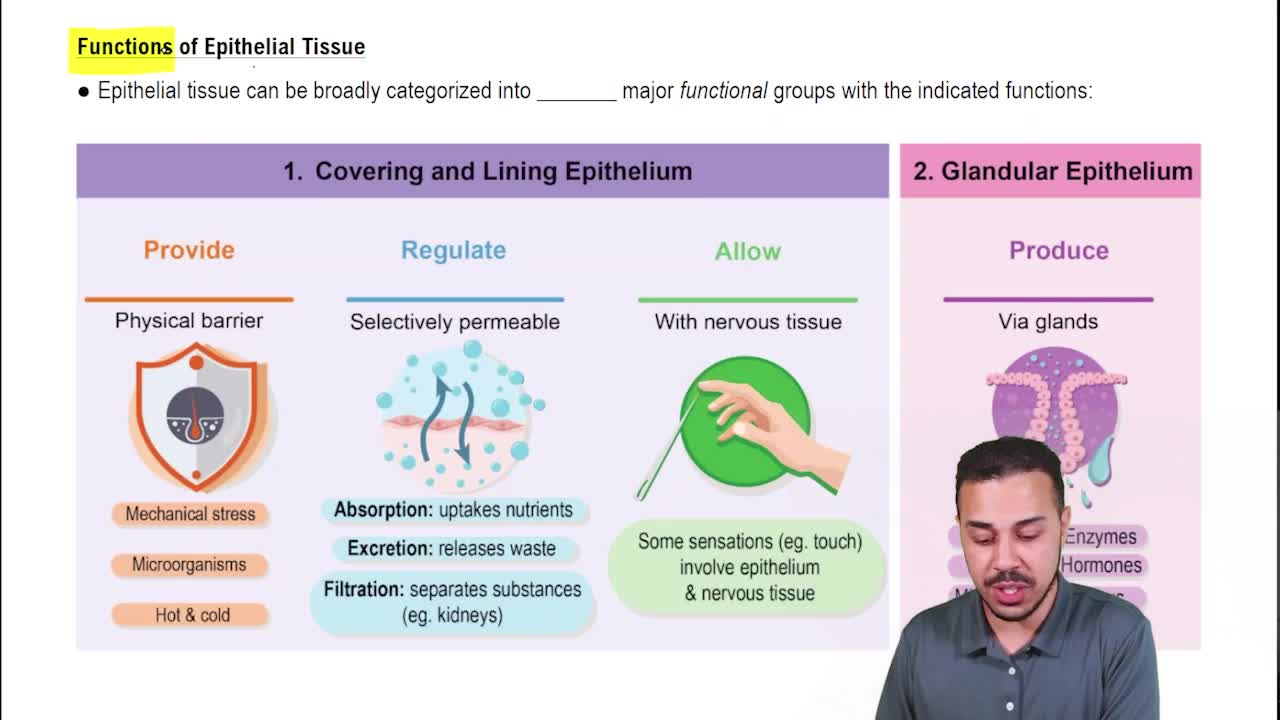
Epithelial tissue is one of the four primary types of tissue in the body, characterized by closely packed cells that form protective layers on surfaces and cavities. It serves various functions, including protection, absorption, secretion, and sensation. Epithelial tissue is classified based on cell shape and the number of layers, such as simple or stratified.
Recommended video:
Guided course
07:25
Functions of Epithelial Tissue

Vascularity

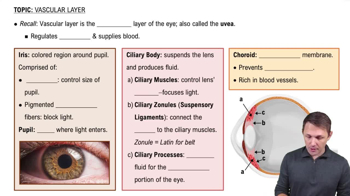
Vascularity refers to the presence of blood vessels within a tissue. Tissues that are highly vascularized, like muscle and connective tissues, receive a rich blood supply, which is essential for nutrient delivery and waste removal. In contrast, epithelial tissues are avascular, meaning they lack blood vessels and rely on diffusion from underlying connective tissues for nourishment.
Recommended video:
Guided course
6:55
Vascular Layer

True/False Statements

True/false statements are assertions that can be evaluated for their accuracy. In the context of the question, determining whether a statement about epithelial tissue is true or false requires an understanding of the characteristics of epithelial tissue. If a statement is false, it must be corrected to reflect accurate biological principles, such as noting that epithelial tissue is avascular rather than highly vascular.
Recommended video:
1:46
Structural Class: Synovial Joints Example 3