
Ch. 16 The Endocrine System
Amerman - Human Anatomy & Physiology 2nd Edition
Amerman2nd EditionHuman Anatomy & PhysiologyISBN: 9780136873822Not the one you use?Change textbook
Chapter 16, Problem 21b

Mark the following statements as true or false. If a statement is false, correct it to make a true statement.
Thyroid hormones and insulin maintain blood glucose concentration during fasting.

Verified step by step guidance
1
Step 1: Begin by analyzing the role of thyroid hormones in blood glucose regulation. Thyroid hormones primarily regulate metabolism and energy production but do not directly maintain blood glucose concentration during fasting.
Step 2: Examine the role of insulin in blood glucose regulation. Insulin lowers blood glucose levels by promoting glucose uptake into cells and storage as glycogen, but during fasting, insulin secretion is reduced.
Step 3: Identify the hormones responsible for maintaining blood glucose concentration during fasting. Glucagon and cortisol are the primary hormones involved in increasing blood glucose levels during fasting by stimulating glycogen breakdown and gluconeogenesis.
Step 4: Determine the accuracy of the statement. The statement is false because thyroid hormones and insulin are not the primary regulators of blood glucose during fasting.
Step 5: Correct the false statement. A true statement would be: 'Glucagon and cortisol maintain blood glucose concentration during fasting.'

Verified video answer for a similar problem:

This video solution was recommended by our tutors as helpful for the problem above.
Was this helpful?

Key Concepts

Here are the essential concepts you must grasp in order to answer the question correctly.

Thyroid Hormones

Thyroid hormones, primarily thyroxine (T4) and triiodothyronine (T3), play a crucial role in regulating metabolism, energy production, and overall growth. While they influence various metabolic processes, they do not directly maintain blood glucose levels during fasting. Instead, their primary function is to increase the basal metabolic rate and support the body's energy needs.
Recommended video:
Guided course
13:06
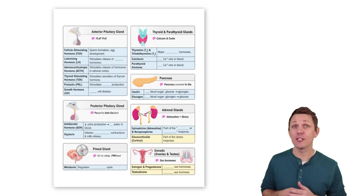
Review of Major Hormones

Insulin

Insulin is a hormone produced by the pancreas that regulates blood glucose levels by facilitating the uptake of glucose into cells, particularly after meals. During fasting, insulin levels decrease, which allows blood glucose levels to rise as the body utilizes stored energy. Therefore, insulin does not maintain blood glucose concentration during fasting; rather, it acts to lower it when food is consumed.
Recommended video:
Guided course
4:31
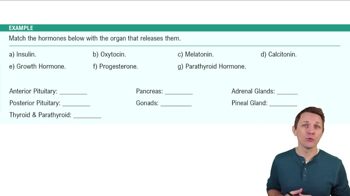
Hormone Review Table Example 1

Blood Glucose Regulation

Blood glucose regulation involves a complex interplay of hormones, including glucagon, cortisol, and epinephrine, which work to maintain glucose levels during fasting. Glucagon, produced by the pancreas, increases blood glucose by promoting glycogen breakdown and gluconeogenesis in the liver. This process is essential for providing energy to the body when food intake is low, contrasting with the roles of thyroid hormones and insulin.
Recommended video:
03:31
Cell Cycle Regulation
Related Practice
Textbook Question

Match the following hormones with their correct descriptions. 

Leptin      

Atrial natriuretic peptide      

Melatonin      

Estrogens      

Erythropoietin      

Testosterone

a. Produced by the pineal gland; regulates the sleep/wake cycle

b. Produced by the kidneys; regulates red blood cell production

c. Produced by the heart; promotes sodium ion loss in the kidneys and vasodilation

d. Produced by the testes; promotes androgenic and anabolic actions

e. Produced by adipose tissue; promotes satiety

f. Produced by the ovaries; regulate the menstrual cycle and the development of secondary sex characteristics

1419
views
Textbook Question

Type 1 diabetes mellitus is characterized by______, and type 2 diabetes mellitus is characterized by_____.

a. hypoglycemia; destruction of the pancreatic β cells

b. destruction of the pancreatic β cells; destruction of the pancreatic α cells

c. insulin resistance; destruction of the pancreatic β cells

d. destruction of the pancreatic β cells; insulin resistance

1234
views
Textbook Question

Mark the following statements as true or false. If a statement is false, correct it to make a true statement.

Both ADH and aldosterone increase the amount of water in the body and decrease the solute concentration of the blood.

1102
views
Textbook Question

Mark the following statements as true or false. If a statement is false, correct it to make a true statement.

Insulin secretion rises during feeding; growth hormone and glucagon are secreted during feeding if protein is present in the meal.

1071
views