Ch. 2 The Chemistry of Life
Amerman - Human Anatomy & Physiology 2nd Edition
Amerman2nd EditionHuman Anatomy & PhysiologyISBN: 9780136873822Not the one you use?Change textbook
Chapter 2, Problem L3.4

Explain how buffer systems in the body work if the pH of body fluids increases. Is this an example of a negative or a positive feedback loop? Explain.

Verified step by step guidance
1
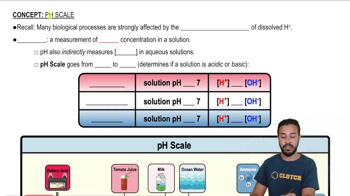
Understand the concept of pH: pH is a measure of hydrogen ion (H⁺) concentration in a solution. A higher pH indicates a decrease in H⁺ concentration, making the solution more basic (alkaline). The normal pH range of body fluids, such as blood, is tightly regulated around 7.35–7.45.
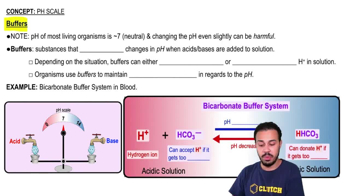
Identify the role of buffer systems: Buffer systems in the body, such as the bicarbonate buffer system, help maintain pH homeostasis by resisting changes in pH. They do this by either releasing H⁺ ions when the pH increases (becomes more basic) or binding H⁺ ions when the pH decreases (becomes more acidic).
Describe the bicarbonate buffer system: The bicarbonate buffer system is the primary buffer in the blood. It involves the reversible reaction: \( \text{H}_2\text{CO}_3 \leftrightarrow \text{H}^+ + \text{HCO}_3^- \). When the pH increases, carbonic acid (\( \text{H}_2\text{CO}_3 \)) dissociates to release H⁺ ions, which helps lower the pH back to normal.
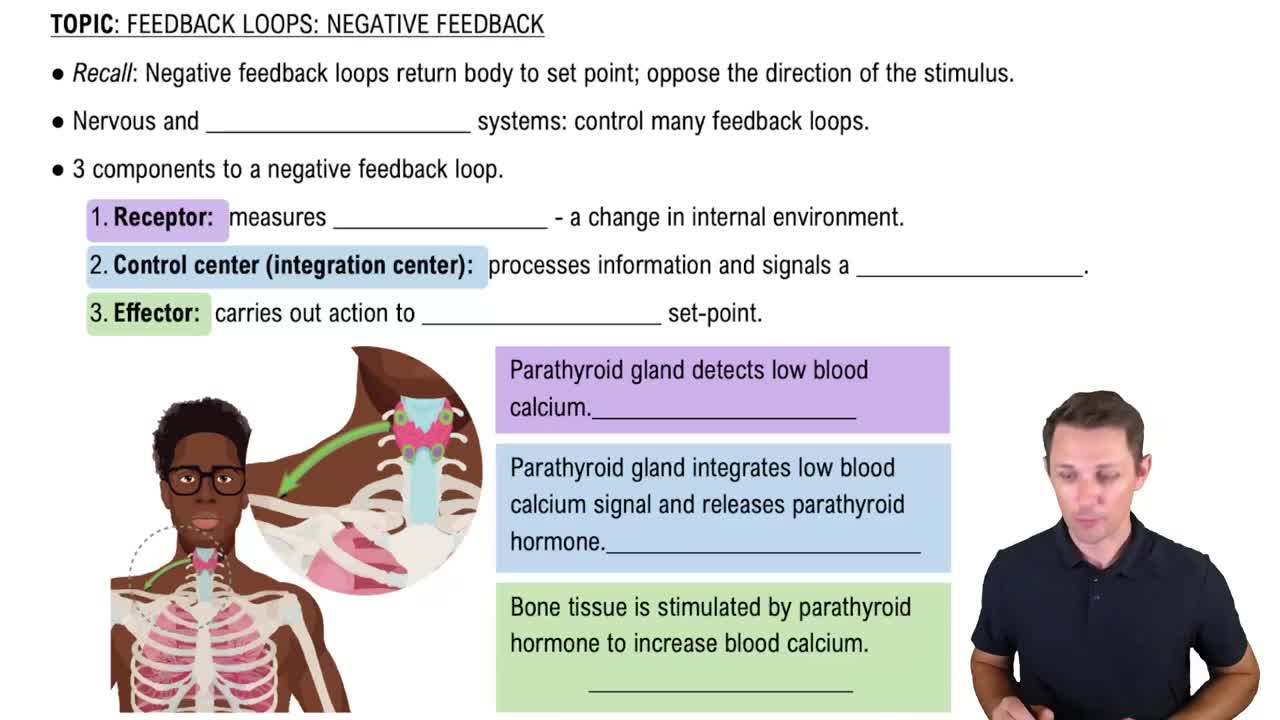
Explain the feedback mechanism: This process is an example of a negative feedback loop. Negative feedback loops work to counteract changes and restore balance. In this case, the buffer system acts to decrease the pH when it rises, maintaining homeostasis.
Summarize the importance: Buffer systems are critical for maintaining the stability of the body's internal environment. Without these systems, even small changes in pH could disrupt cellular processes and lead to severe physiological consequences.

Verified video answer for a similar problem:

This video solution was recommended by our tutors as helpful for the problem above.
Was this helpful?

Key Concepts

Here are the essential concepts you must grasp in order to answer the question correctly.

Buffer Systems

Buffer systems in the body are chemical solutions that resist changes in pH when acids or bases are added. They work by neutralizing excess hydrogen ions (H+) or hydroxide ions (OH-), maintaining a stable pH in body fluids. Key buffers include bicarbonate, phosphate, and proteins, which play crucial roles in physiological processes.
Recommended video:
05:38
Buffers

pH Regulation

pH regulation is essential for maintaining homeostasis in the body, as enzymes and biochemical reactions are highly sensitive to pH changes. When the pH of body fluids increases (becomes more alkaline), buffer systems help to restore balance by releasing H+ ions to lower the pH back to normal levels, ensuring optimal functioning of cellular processes.
Recommended video:
07:58
pH Scale

Negative Feedback Loop

A negative feedback loop is a biological mechanism that counteracts a change in a system to maintain stability. In the context of increased pH, the buffer systems act to lower the pH, demonstrating a negative feedback response. This process helps to return the body to its desired state, contrasting with positive feedback, which amplifies changes.
Recommended video:
Guided course
03:26
Negative Feedback Loops
Related Practice
Textbook Question

Explain the difference between an ionic and a covalent bond.

1395
views

Textbook Question

Identify each of the following molecules or compounds as ionic, polar covalent, or nonpolar covalent.

a. H2O _________

b. LiI _________

c. C10H22 _________

d. N2 _________

e. MgBr2 _________

f. H2S _________

833
views
Textbook Question

The drug methotrexate is used to treat several different types of cancer and diseases of the immune system. It works by inhibiting an enzyme in the cell necessary for folic acid synthesis. Without folic acid, the cell cannot make nucleotides. What, specifically, does an enzyme do in the cell? Why would inhibiting this enzyme disrupt folic acid synthesis? What effect would a disruption in folic acid synthesis have on the cell as a whole? (Hint: Think about the role that folic acid plays in the cell.) (Connects to Chapter 2)

798
views
Textbook Question

Many drugs and poisons exert their effects by blocking one or more enzymes. How could blocking an enzyme lead to the death of a cell?

1054
views
Textbook Question

The polysaccharide cellulose is not digestible by humans, as we lack the enzyme cellulase, which is required to break it down. Certain dietary supplements contain the enzyme cellulase and claim that being able to break down cellulose will help a person lose weight. But what do you think would happen if we could digest the cellulose we ate?

1006
views
Textbook Question

Some claim that the pH of your blood can be affected by eating acidic foods such as citrus. Do you believe this to be true? Explain your answer. (Hint: What happens when extra hydrogen ions are added to the blood?)

1181
views