Ch. 18 The Cardiovascular System II: The Blood Vessels
Amerman - Human Anatomy & Physiology 2nd Edition
Amerman2nd EditionHuman Anatomy & PhysiologyISBN: 9780136873822Not the one you use?Change textbook
Chapter 18, Problem 6

The two pressures within the systemic arterial circuit are the_____ pressure and _____ pressure. The difference between these two pressures is the_____ pressure.

Verified step by step guidance
1
Step 1: Understand the systemic arterial circuit, which is part of the cardiovascular system responsible for delivering oxygenated blood from the heart to the body and returning deoxygenated blood back to the heart.
Step 2: Identify the two pressures within the systemic arterial circuit. These are the systolic pressure (the pressure during heart contraction) and the diastolic pressure (the pressure during heart relaxation).
Step 3: Recognize that the difference between systolic pressure and diastolic pressure is referred to as the pulse pressure, which reflects the force generated by the heart during each cardiac cycle.
Step 4: Recall the formula for calculating pulse pressure: Ppulse=Psystolic-Pdiastolic, where Psystolic is the systolic pressure and Pdiastolic is the diastolic pressure.
Step 5: To solve the problem, substitute the values of systolic and diastolic pressures into the formula to calculate the pulse pressure, ensuring proper units (e.g., mmHg) are used.

Verified video answer for a similar problem:

This video solution was recommended by our tutors as helpful for the problem above.
Was this helpful?

Key Concepts

Here are the essential concepts you must grasp in order to answer the question correctly.

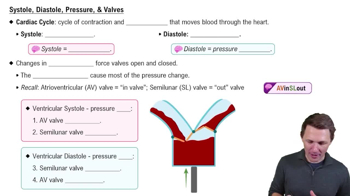
Systolic Pressure

Systolic pressure is the maximum pressure in the arteries during the contraction of the heart's ventricles. It represents the peak force exerted by the blood against the arterial walls when the heart pumps blood into the systemic circulation. This value is typically recorded as the first number in a blood pressure reading.
Recommended video:
Guided course
7:13
Systole, Diastole, Pressure, & Valves

Diastolic Pressure

Diastolic pressure is the minimum pressure in the arteries when the heart is at rest between beats. It reflects the pressure in the arteries when the heart's ventricles are filling with blood. This value is recorded as the second number in a blood pressure reading and is crucial for assessing overall cardiovascular health.
Recommended video:
Guided course
7:13
Systole, Diastole, Pressure, & Valves

Pulse Pressure

Pulse pressure is the difference between systolic and diastolic pressure, indicating the force that the heart generates each time it contracts. It is calculated by subtracting the diastolic pressure from the systolic pressure. A normal pulse pressure is typically around 40 mmHg, and significant deviations can indicate cardiovascular issues.
Recommended video:
Guided course
6:12
Partial Pressure