Ch. 18 The Cardiovascular System II: The Blood Vessels
Amerman - Human Anatomy & Physiology 2nd Edition
Amerman2nd EditionHuman Anatomy & PhysiologyISBN: 9780136873822Not the one you use?Change textbook
Chapter 18, Problem 1e

Mark the following statements as true or false. If a statement is false, correct it to make a true statement.
Veins have smaller lumens, more elastic fibers, and more smooth muscle than arteries.

Verified step by step guidance
1
Step 1: Understand the structural differences between veins and arteries. Veins and arteries are both blood vessels, but they have distinct structural features due to their different functions. Arteries carry blood away from the heart under high pressure, while veins return blood to the heart under lower pressure.
Step 2: Analyze the lumen size. Arteries generally have smaller lumens compared to veins because they need to maintain high pressure to transport blood efficiently. Veins have larger lumens to accommodate the lower pressure and larger volume of blood returning to the heart.
Step 3: Examine the presence of elastic fibers. Arteries contain more elastic fibers than veins because they need to withstand and adapt to the high pressure generated by the heart's pumping action. Veins have fewer elastic fibers as they operate under lower pressure.
Step 4: Assess the amount of smooth muscle. Arteries have more smooth muscle in their walls compared to veins. This smooth muscle helps regulate blood flow and pressure by constricting or dilating the vessel. Veins have less smooth muscle because they rely on valves and surrounding skeletal muscle contractions to move blood.
Step 5: Correct the false statement. The statement 'Veins have smaller lumens, more elastic fibers, and more smooth muscle than arteries' is false. The correct statement is: 'Veins have larger lumens, fewer elastic fibers, and less smooth muscle than arteries.'

Verified video answer for a similar problem:

This video solution was recommended by our tutors as helpful for the problem above.
Was this helpful?

Key Concepts

Here are the essential concepts you must grasp in order to answer the question correctly.

Structure of Blood Vessels

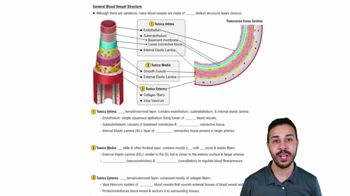
Blood vessels consist of arteries, veins, and capillaries, each with distinct structural features. Arteries have thicker walls with more elastic fibers and smooth muscle to withstand high pressure from the heart. In contrast, veins have thinner walls and larger lumens, which accommodate a greater volume of blood at lower pressure.
Recommended video:
14:36
General Blood Vessel Structure

Function of Veins

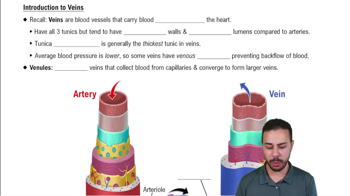
Veins are responsible for returning deoxygenated blood to the heart. They contain valves that prevent backflow and help maintain blood flow against gravity, especially in the limbs. The lower pressure in veins compared to arteries necessitates their larger lumens to facilitate blood return.
Recommended video:
6:24
Introduction to Veins

Comparative Anatomy of Arteries and Veins

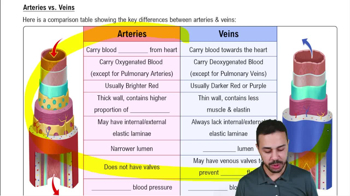
When comparing arteries and veins, it is essential to note that arteries have smaller lumens and are more muscular and elastic, allowing them to handle high-pressure blood flow. Conversely, veins have larger lumens, less smooth muscle, and fewer elastic fibers, which is crucial for their role in low-pressure blood return.
Recommended video:
7:42
Arteries vs. Veins