Ch. 20 The Lymphatic System and Immunity
Amerman - Human Anatomy & Physiology 2nd Edition
Amerman2nd EditionHuman Anatomy & PhysiologyISBN: 9780136873822Not the one you use?Change textbook
Chapter 20, Problem 14

On which type(s) of cells are class I MHC molecules located?
a. Antigen-presenting cells only
b. B cells only
c. All nucleated body cells
d. Antigen-presenting cells and B cells

Verified step by step guidance
1
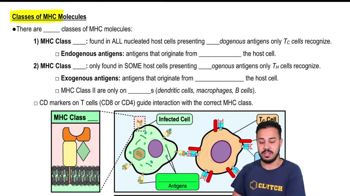
Step 1: Understand the role of class I MHC (Major Histocompatibility Complex) molecules. These molecules are responsible for presenting endogenous antigens (antigens originating from within the cell) to cytotoxic T cells (CD8+ T cells). This process is crucial for immune surveillance and the detection of infected or abnormal cells.
Step 2: Recall the distribution of class I MHC molecules. Class I MHC molecules are expressed on the surface of all nucleated cells in the body. This includes most body cells, as opposed to class II MHC molecules, which are restricted to antigen-presenting cells (APCs) like macrophages, dendritic cells, and B cells.
Step 3: Exclude incorrect options based on the distribution of class I MHC molecules. For example, option 'a' (Antigen-presenting cells only) and option 'b' (B cells only) are incorrect because class I MHC molecules are not limited to these cell types.
Step 4: Consider option 'c' (All nucleated body cells). This is consistent with the fact that class I MHC molecules are found on all nucleated cells, including epithelial cells, muscle cells, and immune cells, but not on non-nucleated cells like red blood cells.
Step 5: Evaluate option 'd' (Antigen-presenting cells and B cells). While APCs and B cells do express class I MHC molecules, this option is incomplete because it excludes other nucleated cells that also express class I MHC molecules. Therefore, option 'c' is the most accurate answer.

Verified video answer for a similar problem:

This video solution was recommended by our tutors as helpful for the problem above.
Was this helpful?

Key Concepts

Here are the essential concepts you must grasp in order to answer the question correctly.

Class I MHC Molecules

Class I Major Histocompatibility Complex (MHC) molecules are proteins found on the surface of all nucleated cells in the body. They play a crucial role in the immune system by presenting endogenous antigens (from within the cell) to CD8+ cytotoxic T cells, which are essential for recognizing and eliminating infected or cancerous cells.
Recommended video:
7:17
Classes of MHC Molecules

Nucleated Cells

Nucleated cells are cells that contain a nucleus, which houses the cell's genetic material. This includes most body cells, except for mature red blood cells and platelets. The presence of a nucleus allows these cells to express Class I MHC molecules, enabling them to present antigens to the immune system.
Recommended video:
05:33
Cell Junctions

Antigen-Presenting Cells (APCs)

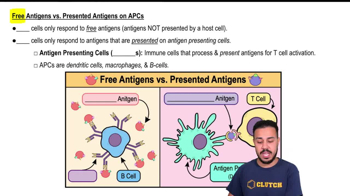
Antigen-presenting cells (APCs) are specialized immune cells, such as dendritic cells, macrophages, and B cells, that capture, process, and present antigens to T cells. While Class I MHC molecules are present on all nucleated cells, APCs also express Class II MHC molecules, which present exogenous antigens to CD4+ helper T cells, highlighting their role in initiating immune responses.
Recommended video:
4:11
Free Antigens vs. Presented Antigens on APCs