Ch. 4 Histology
Amerman - Human Anatomy & Physiology 2nd Edition
Amerman2nd EditionHuman Anatomy & PhysiologyISBN: 9780136873822Not the one you use?Change textbook
Chapter 4, Problem 5a

Mark the following statements as true or false. If a statement is false, correct it to make a true statement.
Epithelial tissues are classified by cell shape and the number of cell layers.

Verified step by step guidance
1
Understand the statement: The problem asks whether epithelial tissues are classified based on cell shape and the number of cell layers. This requires knowledge of how epithelial tissues are categorized in Anatomy & Physiology.
Recall the classification criteria for epithelial tissues: Epithelial tissues are indeed classified based on two main criteria: (1) the shape of the cells (e.g., squamous, cuboidal, columnar) and (2) the number of cell layers (e.g., simple for one layer, stratified for multiple layers).
Evaluate the statement: Based on the criteria mentioned above, determine whether the statement is true or false. In this case, the statement is true because it aligns with the classification criteria.
If the statement were false, correct it: For example, if the statement incorrectly claimed that epithelial tissues are classified by their function instead of cell shape and layers, you would correct it to reflect the proper classification criteria.
Conclude the evaluation: Since the statement is true, no correction is needed. If it were false, the corrected version would be provided as the final step.

Verified video answer for a similar problem:

This video solution was recommended by our tutors as helpful for the problem above.
Was this helpful?

Key Concepts

Here are the essential concepts you must grasp in order to answer the question correctly.

Epithelial Tissue Classification

Epithelial tissues are classified based on two main criteria: cell shape and the number of cell layers. The cell shapes can be squamous (flat), cuboidal (cube-shaped), or columnar (tall and column-like), while the number of layers can be simple (one layer) or stratified (multiple layers). This classification helps in understanding the function and location of different epithelial types in the body.
Recommended video:
Guided course
07:25
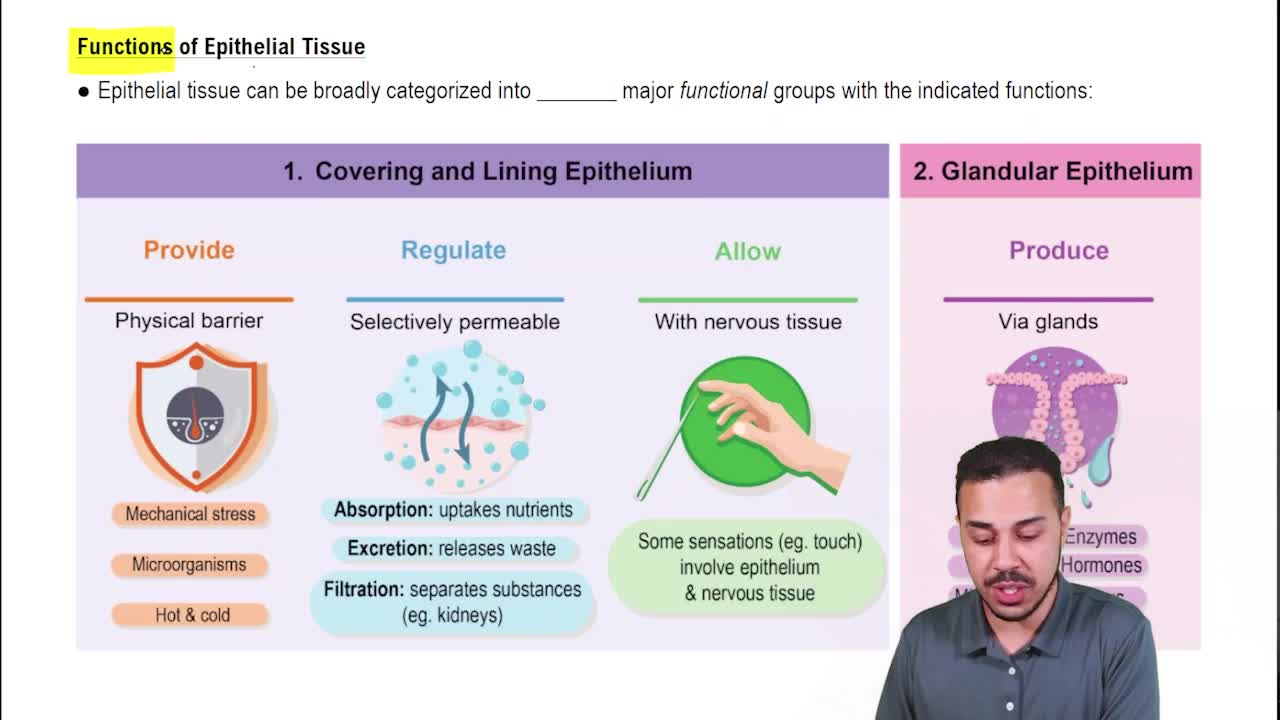
Functions of Epithelial Tissue

Cell Shape

The shape of epithelial cells is crucial for their function. Squamous cells facilitate diffusion and filtration due to their thinness, cuboidal cells are involved in secretion and absorption, and columnar cells often contain microvilli or cilia, enhancing their absorptive or motile capabilities. Understanding these shapes aids in identifying the specific roles of various epithelial tissues.
Recommended video:
Guided course
5:45
Forces That Shape the Lungs

Number of Cell Layers

The number of cell layers in epithelial tissue affects its protective and absorptive functions. Simple epithelium allows for efficient exchange of materials, while stratified epithelium provides a robust barrier against mechanical stress and pathogens. This distinction is essential for recognizing how different epithelial types contribute to overall tissue function and health.
Recommended video:
03:19
Introduction to Layers of the Epidermis