Ch. 14 The Autonomous Nervous System and Homeostasis
Amerman - Human Anatomy & Physiology 2nd Edition
Amerman2nd EditionHuman Anatomy & PhysiologyISBN: 9780136873822Not the one you use?Change textbook
Chapter 14, Problem 9b

Mark the following statements as true or false. If a statement is false, correct it to make a true statement.
b. Sympathetic stimulation increases sweat secretion.

Verified step by step guidance
1
Step 1: Begin by understanding the role of the sympathetic nervous system in the body. The sympathetic nervous system is part of the autonomic nervous system and is responsible for the 'fight or flight' response, which prepares the body to respond to stress or danger.
Step 2: Recall the physiological effects of sympathetic stimulation. It generally increases heart rate, dilates airways, redirects blood flow to muscles, and activates sweat glands to help regulate body temperature during stress.
Step 3: Evaluate the statement provided: 'Sympathetic stimulation increases sweat secretion.' Based on the physiological role of the sympathetic nervous system, this statement is true because sweat secretion is controlled by sympathetic activation of sweat glands.
Step 4: If the statement were false, you would need to correct it by identifying the proper relationship between sympathetic stimulation and sweat secretion. For example, if the statement incorrectly said 'Sympathetic stimulation decreases sweat secretion,' you would correct it to 'Sympathetic stimulation increases sweat secretion.'
Step 5: Conclude by confirming the accuracy of the statement and ensuring the student understands the connection between sympathetic stimulation and sweat gland activity.

Verified video answer for a similar problem:

This video solution was recommended by our tutors as helpful for the problem above.
Was this helpful?

Key Concepts

Here are the essential concepts you must grasp in order to answer the question correctly.

Sympathetic Nervous System

The sympathetic nervous system is a part of the autonomic nervous system that prepares the body for 'fight or flight' responses. It increases heart rate, dilates airways, and stimulates sweat glands, among other functions. Understanding its role is crucial for analyzing how it affects bodily functions like sweat secretion.
Recommended video:
1:21
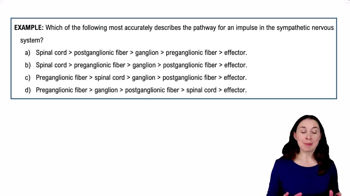
Sympathetic Nervous System Example 3

Sweat Secretion Mechanism

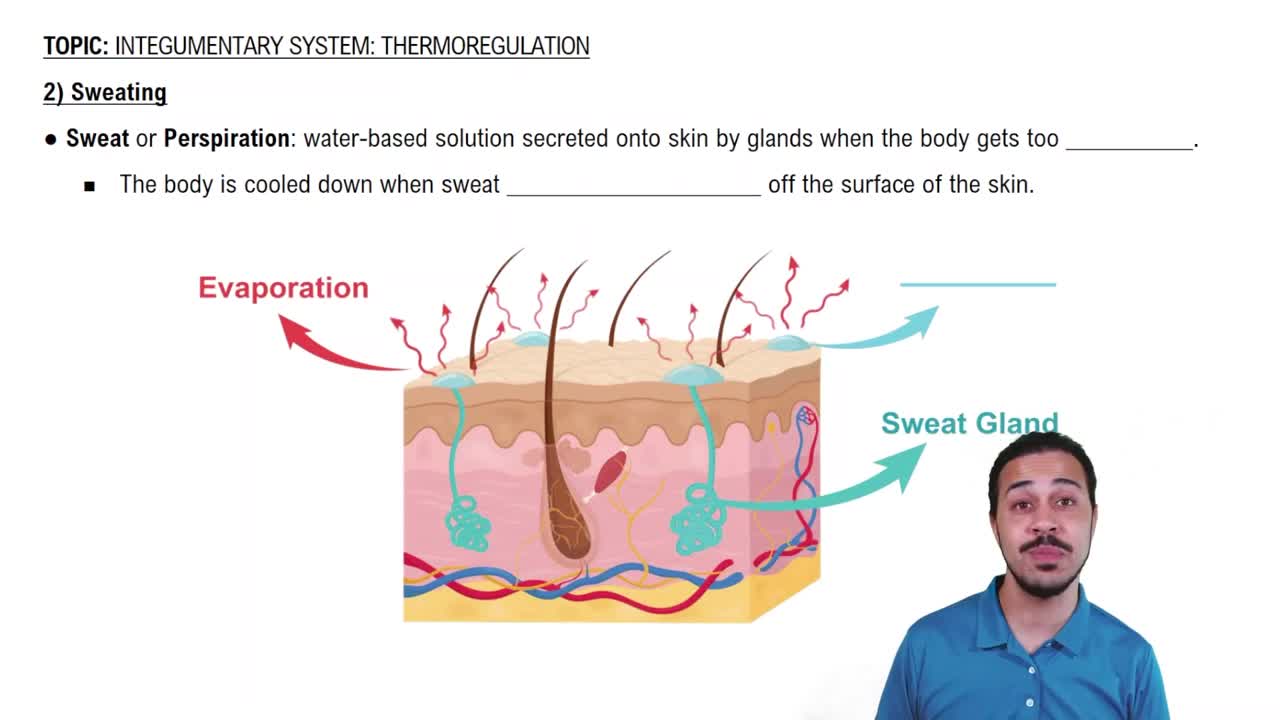
Sweat secretion is primarily controlled by the autonomic nervous system, particularly through the activation of sweat glands. The sympathetic nervous system stimulates eccrine sweat glands to produce sweat, which helps regulate body temperature. This mechanism is essential for understanding the physiological response to heat and stress.
Recommended video:
01:22
Sweating

Homeostasis

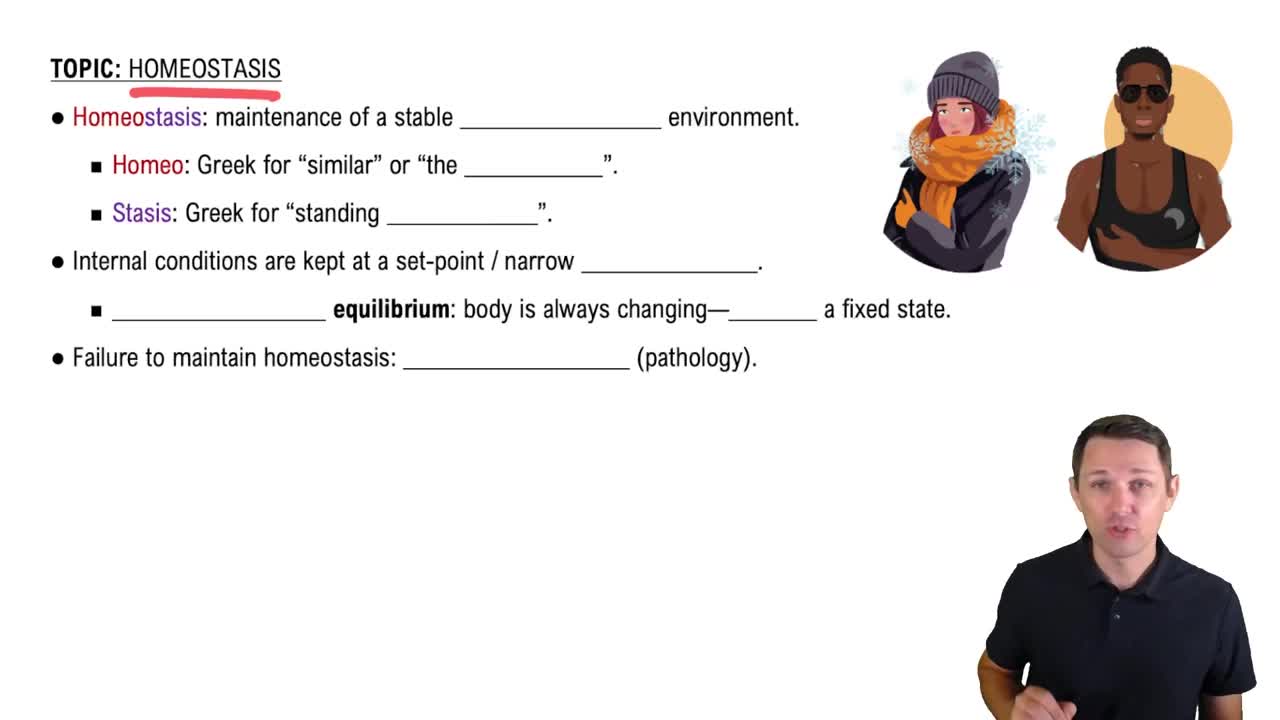
Homeostasis refers to the body's ability to maintain stable internal conditions despite external changes. The regulation of sweat secretion is a key component of thermoregulation, which is part of homeostasis. Understanding this concept helps clarify why sympathetic stimulation leads to increased sweat production during stress or heat.
Recommended video:
Guided course
01:59
Introduction to Homeostasis
Related Practice
Textbook Question

________ receptors are located on parasympathetic postganglionic neurons, and________ receptors are located on parasympathetic target cells.

655
views
Textbook Question

Which of the following actions would you expect when sympathetic neurons release norepinephrine onto β1 receptors?

a. Decreased sweat production

b. Constriction of blood vessels serving the digestive, urinary, and integumentary systems

c. Adjustment of the shape of the lens

d. Increase in the rate and force of contraction of the heart.

700
views
Textbook Question

Mark the following statements as true or false. If a statement is false, correct it to make a true statement.

d. Sympathetic tone controls the resting rate of the heart.

692
views
Textbook Question

Mark the following statements as true or false. If a statement is false, correct it to make a true statement.

a. The parasympathetic nervous system generally decreases the secretion from digestive glands.

739
views
Textbook Question

Mark each of the following as an effect of the sympathetic nervous system or the parasympathetic nervous system.

a. ________ Bronchodilation

b.________ Bronchoconstriction

c. ________ Constriction of pupil

d. ________ Vasoconstriction of blood vessels serving organs of digestive, urinary, and integumentary systems

e. ________ Increased metabolic rate

f. ________ Dilation of pupil

g.________ Contraction of smooth muscle of digestive tract

750
views
Textbook Question

Mark the following statements as true or false. If a statement is false, correct it to make a true statement.

c. The parasympathetic nervous system releases acetylcholine onto all its synapses.

670
views