
Ch. 2 The Chemistry of Life
Amerman - Human Anatomy & Physiology 2nd Edition
Amerman2nd EditionHuman Anatomy & PhysiologyISBN: 9780136873822Not the one you use?Change textbook
Chapter 2, Problem 17

Why is it important for a protein to maintain its structure? What is it called when a protein loses its structure?

Verified step by step guidance
1
Understand that a protein's structure is directly related to its function. Proteins have specific shapes that allow them to interact with other molecules in the body, such as enzymes binding to substrates or antibodies recognizing antigens.
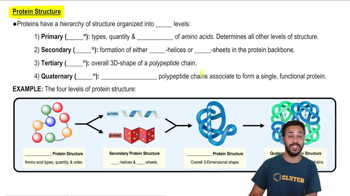
Learn about the levels of protein structure: primary (amino acid sequence), secondary (alpha-helices and beta-sheets), tertiary (3D folding), and quaternary (multiple polypeptide chains). Each level contributes to the overall shape and function of the protein.
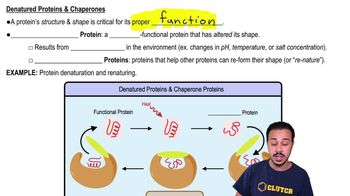
Recognize that when a protein loses its structure, it is called 'denaturation.' Denaturation can occur due to factors like changes in temperature, pH, or exposure to chemicals, which disrupt the bonds maintaining the protein's shape.
Understand that denaturation often leads to a loss of function because the protein can no longer interact with its target molecules properly. For example, an enzyme may lose its ability to catalyze reactions if its active site is altered.
Consider the biological implications of protein denaturation, such as in diseases (e.g., prion diseases) or in everyday processes like cooking (e.g., heat denatures egg proteins). This highlights the importance of maintaining proper conditions for protein stability in living organisms.

Verified video answer for a similar problem:

This video solution was recommended by our tutors as helpful for the problem above.
Was this helpful?

Key Concepts

Here are the essential concepts you must grasp in order to answer the question correctly.

Protein Structure

Proteins are complex molecules made up of amino acids, and their function is heavily dependent on their three-dimensional structure. This structure is organized into four levels: primary, secondary, tertiary, and quaternary. Each level of structure contributes to the protein's overall shape and stability, which is crucial for its biological activity.
Recommended video:
04:53
Protein Structure

Denaturation

Denaturation is the process by which a protein loses its native structure due to external factors such as heat, pH changes, or chemical exposure. This structural change can lead to a loss of function, as the specific shape of the protein is essential for its interaction with other molecules. Denatured proteins may aggregate or become inactive, impacting cellular processes.
Recommended video:
04:00
Denatured Proteins & Chaperones

Protein Function

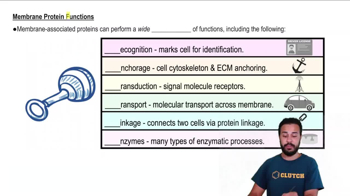
The function of a protein is directly linked to its structure, as the arrangement of amino acids determines how the protein interacts with other molecules. Proteins serve various roles in biological systems, including catalyzing reactions (enzymes), providing structural support, and facilitating communication between cells. Maintaining structural integrity is vital for these functions to occur effectively.
Recommended video:
03:54
Membrane Protein Functions
Related Practice
Textbook Question

Mark the following properties as belonging to either DNA or RNA.


a. Contains the nucleotides A, G, C, and U _________          

b. Found only in the nucleus of the cell   _________       

c. Can move in and out of the cell's nucleus _________         

d. Contains two strands of nucleotides linked by hydrogen bonds _________          

e. Contains the code for every protein in the body _________          

f. Contains the sugar ribose _________          

752
views
Textbook Question

Mark the following statements as true or false. If a statement is false, correct it to make a true statement.

Proteins are composed of strings of fatty acids linked by glycosidic bonds.

838
views
Textbook Question

Which of the following statements is/are true regarding ATP?

a. It is the body's primary source of chemical energy.

b. Its production is the main reason humans breathe oxygen.

c. It is produced using the energy from the oxidation of molecular fuels like glucose.

d. All of the above statements are true.

1258
views
Textbook Question

Mark the following statements as true or false. If a statement is false, correct it to make a true statement.

The main storage form of glucose in the human body is starch.

848
views
Textbook Question

Mark the following statements as true or false. If a statement is false, correct it to make a true statement.

Lipids contain oxygen and are therefore polar covalent compounds.

747
views
Textbook Question

Which of the following is not part of a nucleotide?

a. An amino acid

b. A nitrogenous base

c. One or more phosphate groups

d. A sugar

922
views