Ch. 24 The Urinary System
Amerman - Human Anatomy & Physiology 2nd Edition
Amerman2nd EditionHuman Anatomy & PhysiologyISBN: 9780136873822Not the one you use?Change textbook
Chapter 24, Problem 7a

Mark the following statements as true or false. If a statement is false, correct it to make a true statement.
a. Sodium ions and glucose are cotransported into the proximal tubule cell by secondary active transport.

Verified step by step guidance
1
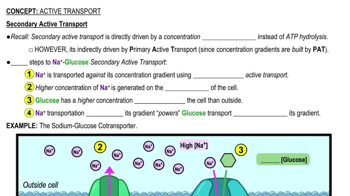
Understand the concept of secondary active transport: Secondary active transport involves the movement of one substance (e.g., sodium ions) down its concentration gradient, which provides the energy to transport another substance (e.g., glucose) against its concentration gradient. This process typically relies on a carrier protein.
Analyze the statement: 'Sodium ions and glucose are cotransported into the proximal tubule cell by secondary active transport.' This suggests that sodium ions and glucose are moved together into the proximal tubule cell using a specific transport mechanism.
Recall the role of the sodium-glucose cotransporter (SGLT): In the proximal tubule of the nephron, sodium ions and glucose are indeed cotransported into the cell by the SGLT protein. Sodium moves down its electrochemical gradient, and this energy is used to transport glucose against its gradient.
Determine if the statement is true or false: Based on the physiological process described, the statement is true because sodium ions and glucose are cotransported into the proximal tubule cell by secondary active transport.
If the statement were false, the correction would involve identifying the incorrect part and revising it. For example, if the statement incorrectly mentioned 'primary active transport,' the correction would be: 'Sodium ions and glucose are cotransported into the proximal tubule cell by secondary active transport.'

Verified video answer for a similar problem:

This video solution was recommended by our tutors as helpful for the problem above.
Was this helpful?

Key Concepts

Here are the essential concepts you must grasp in order to answer the question correctly.

Secondary Active Transport

Secondary active transport is a mechanism that moves ions or molecules across a cell membrane against their concentration gradient, using the energy derived from the movement of another substance down its gradient. This process often involves the coupling of the transport of one substance, like sodium ions, with another, such as glucose, allowing cells to uptake essential nutrients efficiently.
Recommended video:
06:57
Secondary Active Transport

Cotransport

Cotransport refers to the simultaneous transport of two different substances across a cell membrane. In the context of secondary active transport, it typically involves one substance moving down its concentration gradient, which provides the energy needed to transport another substance against its gradient. This is crucial for nutrient absorption in various tissues, including the kidneys.
Recommended video:
1:17
Renal Physiology Step 2: Tubular Reabsorption Example 2

Proximal Tubule Function

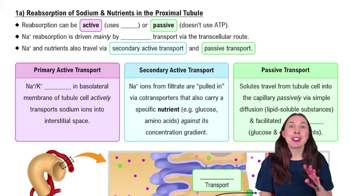
The proximal tubule is a segment of the nephron in the kidney responsible for reabsorbing a significant portion of filtered substances, including glucose and ions. It utilizes mechanisms like secondary active transport to reclaim these vital nutrients from the filtrate back into the bloodstream, playing a key role in maintaining homeostasis and fluid balance in the body.
Recommended video:
6:51
1a) Reabsorption of Sodium & Nutrients in the Proximal Tubule