Ch. 7 The Skeletal System
Amerman - Human Anatomy & Physiology 2nd Edition
Amerman2nd EditionHuman Anatomy & PhysiologyISBN: 9780136873822Not the one you use?Change textbook
Chapter 7, Problem 8d

Mark the following statements as true or false. If a statement is false, correct it to make a true statement.


d. The sacral, coccygeal, and cervical vertebrae are fused in an adult.

Verified step by step guidance
1
Step 1: Understand the anatomy of the vertebral column. The vertebral column is divided into five regions: cervical, thoracic, lumbar, sacral, and coccygeal. Each region has a specific number of vertebrae.
Step 2: Recall the characteristics of the sacral vertebrae. In adults, the sacral vertebrae (typically five) are fused to form a single structure called the sacrum.
Step 3: Recall the characteristics of the coccygeal vertebrae. The coccygeal vertebrae (usually three to five) are also fused in adults to form the coccyx, commonly referred to as the tailbone.
Step 4: Recall the characteristics of the cervical vertebrae. The cervical vertebrae (seven in total) remain separate and are not fused in adults. They allow for movement of the neck and head.
Step 5: Based on the above information, determine the accuracy of the statement. If the statement is false, correct it by stating that only the sacral and coccygeal vertebrae are fused in adults, while the cervical vertebrae remain separate.

Verified video answer for a similar problem:

This video solution was recommended by our tutors as helpful for the problem above.
Was this helpful?

Key Concepts

Here are the essential concepts you must grasp in order to answer the question correctly.

Vertebral Column Anatomy

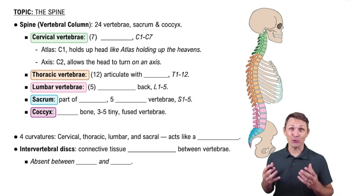
The vertebral column, or spine, consists of 33 vertebrae divided into five regions: cervical, thoracic, lumbar, sacral, and coccygeal. In adults, the sacral vertebrae (typically five) are fused to form the sacrum, and the coccygeal vertebrae (usually four) form the coccyx. However, the cervical vertebrae remain separate and are not fused.
Recommended video:
Guided course
6:29
Spine (Vertebral Column)

Fused vs. Unfused Vertebrae

Fused vertebrae refer to vertebrae that have grown together to form a single bone structure, which is common in the sacral and coccygeal regions. In contrast, unfused vertebrae, such as those in the cervical and thoracic regions, allow for greater flexibility and movement. Understanding which vertebrae are fused is crucial for accurately describing spinal anatomy.
Recommended video:
Guided course
6:29
Spine (Vertebral Column)

True/False Statement Correction

In academic contexts, evaluating statements as true or false requires a clear understanding of the underlying facts. When a statement is false, it is important to identify the error and provide a corrected version. This process enhances critical thinking and reinforces knowledge of the subject matter, particularly in anatomy where precision is vital.
Recommended video:
1:46
Structural Class: Synovial Joints Example 3