Ch. 2 The Chemistry of Life
Amerman - Human Anatomy & Physiology 2nd Edition
Amerman2nd EditionHuman Anatomy & PhysiologyISBN: 9780136873822Not the one you use?Change textbook
Chapter 2, Problem 1b

Mark the following statements as true or false. If a statement is false, correct it to make a true statement.
Protons and neutrons have a positive charge and electrons have a negative charge.

Verified step by step guidance
1
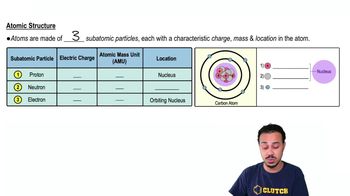
Step 1: Understand the charges of subatomic particles. Protons have a positive charge (+1), neutrons have no charge (neutral), and electrons have a negative charge (-1).
Step 2: Analyze the given statement: 'Protons and neutrons have a positive charge and electrons have a negative charge.'
Step 3: Identify the error in the statement. The error is that neutrons are incorrectly described as having a positive charge, whereas they are actually neutral (no charge).
Step 4: Correct the false statement. The corrected statement should read: 'Protons have a positive charge, neutrons are neutral, and electrons have a negative charge.'
Step 5: Mark the original statement as false and provide the corrected version as the true statement.

Verified video answer for a similar problem:

This video solution was recommended by our tutors as helpful for the problem above.
Was this helpful?

Key Concepts

Here are the essential concepts you must grasp in order to answer the question correctly.

Charge of Subatomic Particles

Subatomic particles are the building blocks of atoms, and they carry specific electric charges. Protons have a positive charge, neutrons are neutral (no charge), and electrons have a negative charge. Understanding these charges is essential for grasping atomic structure and chemical behavior.
Recommended video:
04:48
Atomic Structure

Atomic Structure

Atoms consist of a nucleus, which contains protons and neutrons, surrounded by electrons in various energy levels. The arrangement and interaction of these particles determine the atom's properties and its behavior in chemical reactions. Recognizing the roles of protons, neutrons, and electrons is fundamental to the study of chemistry and physics.
Recommended video:
04:48
Atomic Structure

True/False Statements in Science

In scientific inquiry, statements can be evaluated as true or false based on empirical evidence and established theories. Correcting false statements involves understanding the underlying principles and providing accurate information. This process is crucial for developing critical thinking and analytical skills in scientific contexts.
Recommended video:
1:46
Structural Class: Synovial Joints Example 3