
Textbook Question
Mark the following statements as true or false. If a statement is false, correct it to make a true statement.
Increased amounts of blood flowing through the dermis lead to pallor in the skin.
796
views

 Verified step by step guidance
 02:33
02:33
 03:18
03:18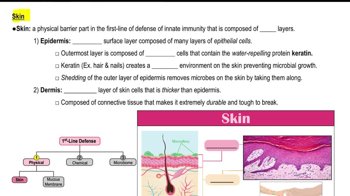 4:08
4:08Mark the following statements as true or false. If a statement is false, correct it to make a true statement.
Increased amounts of blood flowing through the dermis lead to pallor in the skin.
Which type of burn involves the epidermis and all or part of the dermis?
a. First-degree burn
b. Second-degree burn
c. Third-degree burn
d. Fourth-degree burn
Epidermal ridges are created by:
a. The epidermal papillae
b. Mounds of papillary dermis arranged into dermal ridges
c. Gaps between collagen bundles in the reticular layer
d. Tight binding of the reticular layer to deeper structures
Mark the following statements as true or false. If a statement is false, correct it to make a true statement.
The primary skin pigment is melanin, which is derived from the amino acid tyrosine.
Mark the following statements as true or false. If a statement is false, correct it to make a true statement.
The pigment hemoglobin in red blood cells gives skin a pinkish hue when it binds high amounts of oxygen.
Mark the following statements as true or false. If a statement is false, correct it to make a true statement.
Melanin is produced by melanocytes and covers the nuclei of neighboring dendritic cells.