
Ch. 25 Fluids, Electrolytes, and Acid-Base Homeostasis
Amerman - Human Anatomy & Physiology 2nd Edition
Amerman2nd EditionHuman Anatomy & PhysiologyISBN: 9780136873822Not the one you use?Change textbook
Chapter 25, Problem 6e

Mark the following statements as true or false. If a statement is false, correct it to make a true statement.
e. Dehydration is characterized by a decreased volume and increased osmolarity of the ECF.

Verified step by step guidance
1
Step 1: Understand the key terms in the statement. 'Dehydration' refers to a condition where the body loses more water than it takes in, leading to an imbalance in fluid levels. 'ECF' stands for extracellular fluid, which is the fluid outside of cells. 'Osmolarity' refers to the concentration of solutes in a solution.
Step 2: Analyze the statement provided. It claims that dehydration is characterized by a decreased volume and increased osmolarity of the ECF. Consider whether this aligns with the physiological effects of dehydration.
Step 3: Recall the physiological effects of dehydration. When the body loses water, the volume of the ECF decreases because water is a major component of this fluid. Additionally, the loss of water without a proportional loss of solutes increases the concentration of solutes in the ECF, leading to increased osmolarity.
Step 4: Determine if the statement is true or false. Based on the physiological explanation, the statement is true because dehydration does indeed result in a decreased volume and increased osmolarity of the ECF.
Step 5: If the statement were false, you would need to correct it. For example, if the statement incorrectly claimed that dehydration decreases osmolarity, you would correct it to state that dehydration increases osmolarity due to water loss.

Verified video answer for a similar problem:

This video solution was recommended by our tutors as helpful for the problem above.
Was this helpful?

Key Concepts

Here are the essential concepts you must grasp in order to answer the question correctly.

Dehydration

Dehydration refers to a state in which the body loses more fluids than it takes in, leading to a deficit in total body water. This condition can result from various factors, including excessive sweating, vomiting, diarrhea, or inadequate fluid intake. In the context of extracellular fluid (ECF), dehydration typically results in a decrease in volume and an increase in osmolarity, as the concentration of solutes becomes higher when water is lost.
Recommended video:
04:19
Building & Breaking-Down Polymers

Extracellular Fluid (ECF)

Extracellular fluid (ECF) is the body fluid located outside of cells, which includes interstitial fluid and plasma. It plays a crucial role in maintaining homeostasis, transporting nutrients, and facilitating communication between cells. Changes in ECF volume and osmolarity can significantly impact cellular function and overall fluid balance in the body, making it essential to understand these dynamics in conditions like dehydration.
Recommended video:
Guided course
2:39
Intracellular Receptors and Direct Gene Action Example 1

Osmolarity

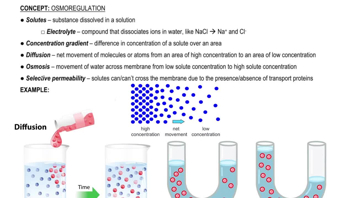
Osmolarity is a measure of the concentration of solute particles in a solution, expressed in osmoles per liter. It is a critical factor in determining the movement of water across cell membranes through osmosis. In dehydration, the osmolarity of the ECF increases due to the loss of water, leading to a higher concentration of solutes, which can affect cellular hydration and function.
Recommended video:
07:59
Osmosis and Osmolarity
Related Practice