Ch. 4 Tissue: The Living Fabric
Marieb - Human Anatomy & Physiology 7th Edition
Marieb, Hoehn7th EditionHuman Anatomy & PhysiologyISBN: 9780805359091Not the one you use?Change textbook
Chapter 4, Problem 10

Define tissue.

Verified step by step guidance
1
A tissue is a group of cells that work together to perform a specific function in the body.
Tissues are organized based on their structure and function, and they are classified into four main types: epithelial, connective, muscle, and nervous tissue.
Epithelial tissue covers body surfaces, lines cavities, and forms glands, providing protection, secretion, and absorption.
Connective tissue supports, binds, and protects other tissues and organs, and includes types like bone, blood, and adipose tissue.
Muscle tissue is responsible for movement, while nervous tissue is specialized for communication and control through electrical impulses.

Verified video answer for a similar problem:

This video solution was recommended by our tutors as helpful for the problem above.
Video duration:
1m
Was this helpful?

Key Concepts

Here are the essential concepts you must grasp in order to answer the question correctly.

Definition of Tissue

A tissue is a group of similar cells that work together to perform a specific function. It forms the structural and functional units in multicellular organisms, enabling complex biological processes.
Recommended video:
4:55
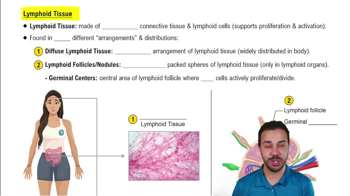
Lymphoid Tissue

Types of Tissues

Tissues are classified into different types based on their structure and function, such as epithelial, connective, muscular, and nervous tissues. Each type plays a unique role in the organism's body.
Recommended video:
Guided course
00:36
3 Types of Muscle Tissue

Role of Tissues in Organisms

Tissues combine to form organs, which carry out specialized tasks essential for survival. Understanding tissues helps explain how organisms maintain structure, support, movement, and communication.
Recommended video:
Guided course
7:12
Organization of Muscle Tissue