Ch. 9 The Muscular System
Amerman - Human Anatomy & Physiology 2nd Edition
Amerman2nd EditionHuman Anatomy & PhysiologyISBN: 9780136873822Not the one you use?Change textbook
Chapter 9, Problem 6d

Mark the following statements as true or false. If the statement is false, correct it to make a true statement.
The buccinator muscle pulls the cheeks in, producing sucking movements.

Verified step by step guidance
1
Step 1: Understand the function of the buccinator muscle. The buccinator is a facial muscle located in the cheek area. Its primary function is to compress the cheeks against the teeth, which aids in actions like chewing, blowing, and sucking.
Step 2: Analyze the statement provided. The statement claims that the buccinator muscle pulls the cheeks in, producing sucking movements.
Step 3: Determine if the statement is true or false. Based on the anatomy and physiology of the buccinator muscle, the statement is true because the muscle does contribute to sucking movements by compressing the cheeks inward.
Step 4: If the statement were false, you would need to correct it. For example, if the statement incorrectly described the buccinator's function, you would clarify its role in compressing the cheeks and aiding in actions like chewing and sucking.
Step 5: Conclude by confirming the accuracy of the statement or providing the corrected version. In this case, the statement is accurate and does not require correction.

Verified video answer for a similar problem:

This video solution was recommended by our tutors as helpful for the problem above.
Was this helpful?

Key Concepts

Here are the essential concepts you must grasp in order to answer the question correctly.

Buccinator Muscle Function

The buccinator muscle is a thin, flat muscle located in the cheek area. Its primary function is to compress the cheeks against the teeth, which aids in actions such as sucking, blowing, and chewing. This muscle plays a crucial role in maintaining the position of food during mastication and preventing it from accumulating in the vestibule of the mouth.
Recommended video:
06:04
Functional Groups

Muscle Actions in Oral Functions

Muscle actions in the oral cavity are essential for various functions, including speech, eating, and facial expressions. The buccinator, along with other muscles like the orbicularis oris, coordinates movements that facilitate sucking and blowing. Understanding these actions helps clarify how different muscles contribute to complex oral behaviors.
Recommended video:
Guided course
5:41
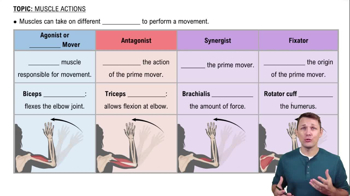
Muscle Actions

True/False Statement Correction

In academic contexts, evaluating statements as true or false requires a clear understanding of the underlying facts. If a statement is false, it is important to identify the error and provide a corrected version. This process enhances critical thinking and reinforces knowledge by encouraging students to engage with the material actively.
Recommended video:
1:46
Structural Class: Synovial Joints Example 3