Ch. 2 The Chemistry of Life
Amerman - Human Anatomy & Physiology 2nd Edition
Amerman2nd EditionHuman Anatomy & PhysiologyISBN: 9780136873822Not the one you use?Change textbook
Chapter 2, Problem 1a

Mark the following statements as true or false. If a statement is false, correct it to make a true statement.
The mass number of an atom is the sum of its neutrons and protons.

Verified step by step guidance
1
Step 1: Understand the concept of mass number. The mass number of an atom is defined as the total number of protons and neutrons in the nucleus of the atom. This is a fundamental concept in chemistry and physics.
Step 2: Analyze the given statement: 'The mass number of an atom is the sum of its neutrons and protons.' Compare this statement to the definition of mass number provided in Step 1.
Step 3: Determine if the statement is true or false. Since the definition of mass number matches the given statement, the statement is true.
Step 4: If the statement were false, you would need to correct it. For example, if the statement incorrectly said 'The mass number of an atom is the sum of its electrons and protons,' you would correct it to 'The mass number of an atom is the sum of its neutrons and protons.'
Step 5: Conclude that the given statement is true and does not require correction.

Verified video answer for a similar problem:

This video solution was recommended by our tutors as helpful for the problem above.
Was this helpful?

Key Concepts

Here are the essential concepts you must grasp in order to answer the question correctly.

Mass Number

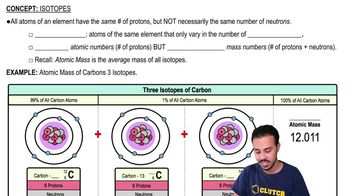
The mass number of an atom is defined as the total number of protons and neutrons in its nucleus. It is a whole number that reflects the atom's overall mass, as protons and neutrons contribute significantly to the atomic mass, while electrons have negligible mass. For example, a carbon atom with 6 protons and 6 neutrons has a mass number of 12.
Recommended video:
06:50
Isotopes

Protons and Neutrons

Protons are positively charged particles found in the nucleus of an atom, while neutrons are neutral particles that also reside in the nucleus. The number of protons determines the atomic number and the element's identity, while neutrons contribute to the mass number and can affect the stability of the nucleus. For instance, isotopes of an element differ in the number of neutrons.
Recommended video:
01:43
Atoms- Smallest Unit of Matter Example 2

Atomic Structure

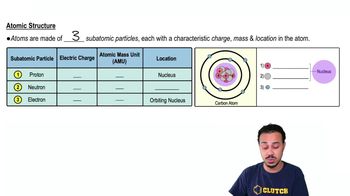
Atomic structure refers to the arrangement of subatomic particles within an atom, including protons, neutrons, and electrons. Understanding atomic structure is crucial for grasping how elements interact, form bonds, and participate in chemical reactions. The nucleus, containing protons and neutrons, is surrounded by a cloud of electrons, which occupy specific energy levels.
Recommended video:
04:48
Atomic Structure