
Ch. 16 The Endocrine System
Amerman - Human Anatomy & Physiology 2nd Edition
Amerman2nd EditionHuman Anatomy & PhysiologyISBN: 9780136873822Not the one you use?Change textbook
Chapter 16, Problem 21d

Mark the following statements as true or false. If a statement is false, correct it to make a true statement.
Insulin secretion rises during feeding; growth hormone and glucagon are secreted during feeding if protein is present in the meal.

Verified step by step guidance
1
Step 1: Understand the role of insulin in the body. Insulin is a hormone secreted by the pancreas that helps regulate blood glucose levels. It is typically secreted in response to elevated blood glucose levels, such as after consuming a meal, especially one high in carbohydrates.
Step 2: Analyze the statement about insulin secretion during feeding. The statement 'Insulin secretion rises during feeding' is true because insulin is released to help cells absorb glucose from the bloodstream after a meal.
Step 3: Examine the role of growth hormone and glucagon. Growth hormone is secreted by the pituitary gland and is involved in promoting growth and metabolism, but its secretion typically decreases during feeding. Glucagon, secreted by the pancreas, works to increase blood glucose levels and is usually secreted during fasting, not feeding.
Step 4: Evaluate the claim about growth hormone and glucagon secretion during feeding if protein is present. While protein consumption can stimulate glucagon secretion to maintain blood glucose levels, growth hormone secretion is not directly stimulated by protein during feeding. Therefore, the statement is false.
Step 5: Correct the false statement. The corrected statement should read: 'Insulin secretion rises during feeding; glucagon may be secreted during feeding if protein is present in the meal, but growth hormone secretion typically decreases during feeding.'

Verified video answer for a similar problem:

This video solution was recommended by our tutors as helpful for the problem above.
Was this helpful?

Key Concepts

Here are the essential concepts you must grasp in order to answer the question correctly.

Insulin Secretion

Insulin is a hormone produced by the pancreas that plays a crucial role in regulating blood glucose levels. Its secretion increases in response to feeding, particularly when carbohydrates are consumed, facilitating the uptake of glucose by cells for energy or storage. Understanding insulin's role is essential for evaluating metabolic responses during and after meals.
Recommended video:
01:33
Protein Secretion

Growth Hormone

Growth hormone (GH) is produced by the pituitary gland and is vital for growth, metabolism, and body composition. While its secretion can be influenced by various factors, it is not typically elevated during feeding. Instead, GH levels may rise during fasting or exercise, making it important to distinguish its secretion patterns in relation to nutrient intake.
Recommended video:
Guided course
4:31
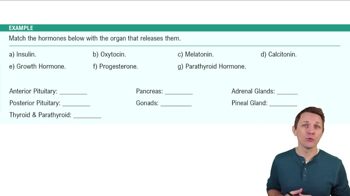
Hormone Review Table Example 1

Glucagon

Glucagon is another hormone produced by the pancreas, primarily responsible for raising blood glucose levels by promoting glycogen breakdown and gluconeogenesis. Its secretion generally increases during fasting or low blood sugar levels rather than during feeding. Understanding glucagon's role helps clarify the hormonal balance during metabolic states.
Recommended video:
Guided course
4:31
Hormone Review Table Example 1