Ch. 1 Introduction to Anatomy and Physiology
Amerman - Human Anatomy & Physiology 2nd Edition
Amerman2nd EditionHuman Anatomy & PhysiologyISBN: 9780136873822Not the one you use?Change textbook
Chapter 1, Problem 8

The upper and lower limbs are known broadly as the________ region.
a. Appendicular
b. Axial
c. Crural
d. Dorsal

Verified step by step guidance
1
Step 1: Understand the terminology used in the question. The question is asking about the broad classification of the upper and lower limbs in terms of anatomical regions.
Step 2: Recall the two main divisions of the human body in anatomy: the axial region and the appendicular region. The axial region includes the head, neck, and trunk, while the appendicular region includes the limbs (upper and lower).
Step 3: Analyze the options provided: a) Appendicular, b) Axial, c) Crural, d) Dorsal. Note that 'appendicular' refers to the limbs, 'axial' refers to the central body, 'crural' refers specifically to the leg region, and 'dorsal' refers to the back.
Step 4: Match the correct term to the description of the upper and lower limbs. Since the limbs are part of the appendicular skeleton, the correct answer is related to the appendicular region.
Step 5: Conclude that the term describing the upper and lower limbs broadly is the appendicular region, based on anatomical classification.

Verified video answer for a similar problem:

This video solution was recommended by our tutors as helpful for the problem above.
Was this helpful?

Key Concepts

Here are the essential concepts you must grasp in order to answer the question correctly.

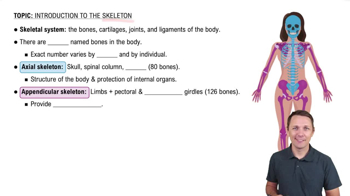
Appendicular Skeleton

The appendicular skeleton comprises the bones of the upper and lower limbs, as well as the girdles that attach them to the axial skeleton. This region is crucial for movement and manipulation of the environment, allowing for a wide range of activities such as walking, grasping, and lifting.
Recommended video:
Guided course
4:50
Skeletal System

Axial Skeleton

The axial skeleton includes the bones that form the central axis of the body, specifically the skull, vertebral column, and rib cage. It serves to protect vital organs, support the head and neck, and provide attachment points for muscles, distinguishing it from the appendicular region.
Recommended video:
Guided course
4:50
Skeletal System

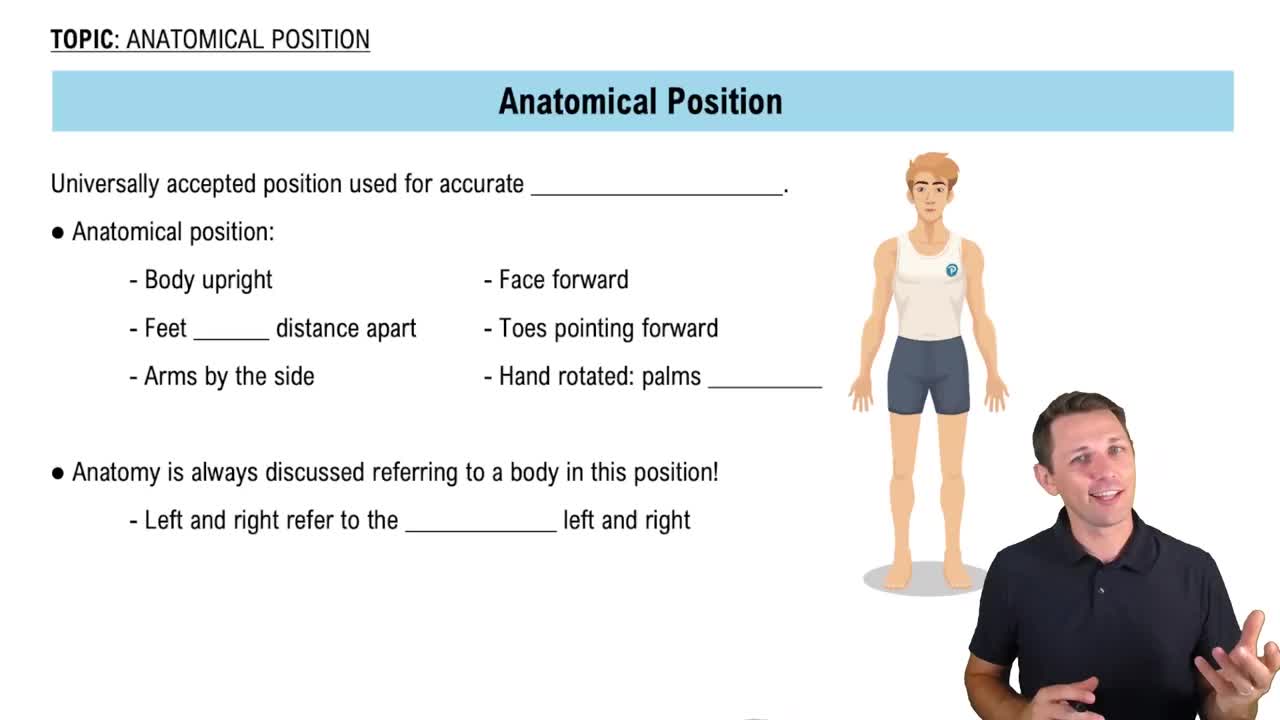
Anatomical Terminology

Anatomical terminology is a standardized language used to describe the locations and relationships of body parts. Understanding terms like 'appendicular' and 'axial' is essential for accurately communicating about the human body and its structures, particularly in fields like anatomy and medicine.
Recommended video:
Guided course
02:40
Anatomical Position
Related Practice
Textbook Question

Mark the following statements as true or false. If a statement is false, correct it to make a true statement.

The anatomical position features the person facing forward, feet shoulder-width apart, and palms facing posteriorly.

684
views
Textbook Question

Match the following terms with the correct definition.

Anterior: -----------a. Toward the back

Lateral:------------b. Closer to the midline      

Proximal: ----------c. Farther away from the point of origin      

Posterior:----------d. Toward the front    

Inferior:------------e. Closer to the point of origin

Distal:------------- f. Toward the head

Medial: -----------g. Away from the body's midline

Superior:----------- h. Toward the tail 

900
views
Textbook Question

The arm is known as the_______region; the neck is known as the _______ region.

a. Otic; axillary

b. Antebrachial; dorsal

c. Brachial; cervical

d. Sural; crural

598
views
1
rank
Textbook Question

A parasagittal section divides the body or body part into:

a. Equal right and left parts

b. Front and back parts

c. Superior/proximal and inferior/distal parts

d. Unequal right and left parts

1359
views
Textbook Question

Which of the following best describes the position of a tissue in the levels of organization of the human body?

a. Tissues are the most fundamental level of organization.

b. Tissues are between cells and organs in the levels of organization.

c. Tissues are the most complex level of organization.

d. Tissues are between organs and systems in the levels of organization.

1205
views
1
rank
Textbook Question

The two divisions of the posterior body cavity are the _____ and______ body cavities.

450
views