Ch. 18 The Cardiovascular System II: The Blood Vessels
Amerman - Human Anatomy & Physiology 2nd Edition
Amerman2nd EditionHuman Anatomy & PhysiologyISBN: 9780136873822Not the one you use?Change textbook
Chapter 18, Problem 12

List three ways in which substances can cross the capillary wall.

Verified step by step guidance
1
Understand that capillary walls are composed of a single layer of endothelial cells, which allow for the exchange of substances between blood and surrounding tissues.
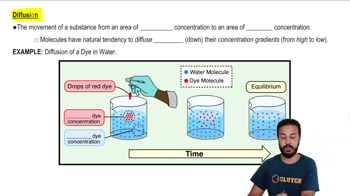
Learn about diffusion, which is the movement of substances from an area of higher concentration to an area of lower concentration. Small, nonpolar molecules like oxygen (O₂) and carbon dioxide (CO₂) can cross the capillary wall via simple diffusion.
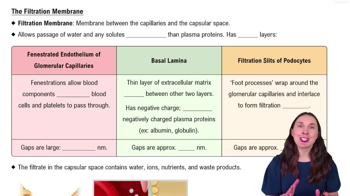
Explore filtration, which occurs due to hydrostatic pressure. This process pushes water and small solutes through gaps or fenestrations in the capillary wall, typically at the arterial end of the capillary.
Examine vesicular transport, which involves endocytosis and exocytosis. Larger molecules, such as proteins, can cross the capillary wall by being enclosed in vesicles and transported across the endothelial cells.
Recognize the role of active transport for substances that require energy to move against their concentration gradient. This mechanism is less common in capillaries but can occur for specific molecules like ions.

Verified video answer for a similar problem:

This video solution was recommended by our tutors as helpful for the problem above.
Was this helpful?

Key Concepts

Here are the essential concepts you must grasp in order to answer the question correctly.

Diffusion

Diffusion is the process by which molecules move from an area of higher concentration to an area of lower concentration. In the context of capillary walls, small, non-polar molecules, such as oxygen and carbon dioxide, can easily diffuse through the lipid bilayer of endothelial cells, allowing for gas exchange between blood and surrounding tissues.
Recommended video:
02:44
Diffusion

Filtration

Filtration is the movement of water and solutes through a membrane due to hydrostatic pressure. In capillaries, this process occurs primarily at the arterial end, where blood pressure forces fluid and small solutes out of the capillaries into the interstitial space, facilitating nutrient delivery and waste removal.
Recommended video:
4:30
The Filtration Membane

Transcytosis

Transcytosis is a cellular process that involves the transport of molecules across the interior of a cell via vesicles. In capillaries, larger molecules, such as proteins, can be engulfed by endothelial cells on one side and released on the other side, allowing for selective transport across the capillary wall.