Ch. 18 The Cardiovascular System II: The Blood Vessels
Amerman - Human Anatomy & Physiology 2nd Edition
Amerman2nd EditionHuman Anatomy & PhysiologyISBN: 9780136873822Not the one you use?Change textbook
Chapter 18, Problem 1c

Mark the following statements as true or false. If a statement is false, correct it to make a true statement.
Arteries always carry oxygenated blood away from the heart, and veins always carry deoxygenated blood toward the heart.

Verified step by step guidance
1
Step 1: Understand the statement provided. The statement claims that arteries always carry oxygenated blood away from the heart, and veins always carry deoxygenated blood toward the heart. This is a common misconception in Anatomy & Physiology.
Step 2: Recall the definition and function of arteries and veins. Arteries are blood vessels that carry blood away from the heart, while veins are blood vessels that carry blood toward the heart. The oxygenation status of the blood depends on the specific circulatory pathway.
Step 3: Analyze the exceptions to the statement. In the pulmonary circulation, the pulmonary arteries carry deoxygenated blood from the heart to the lungs, and the pulmonary veins carry oxygenated blood from the lungs to the heart. This is opposite to the general rule in systemic circulation.
Step 4: Determine the truth of the statement. Based on the analysis, the statement is false because arteries do not always carry oxygenated blood, and veins do not always carry deoxygenated blood. The pulmonary circulation is an exception.
Step 5: Correct the false statement. A true statement would be: 'Arteries carry blood away from the heart, and veins carry blood toward the heart. In systemic circulation, arteries generally carry oxygenated blood, and veins generally carry deoxygenated blood. However, in pulmonary circulation, the pulmonary arteries carry deoxygenated blood, and the pulmonary veins carry oxygenated blood.'

Verified video answer for a similar problem:

This video solution was recommended by our tutors as helpful for the problem above.
Was this helpful?

Key Concepts

Here are the essential concepts you must grasp in order to answer the question correctly.

Oxygenated and Deoxygenated Blood

Oxygenated blood is rich in oxygen and is typically carried away from the heart by arteries, while deoxygenated blood, which has delivered its oxygen to the tissues, is carried back to the heart by veins. However, there are exceptions, such as the pulmonary arteries and veins, which transport deoxygenated blood from the heart to the lungs and oxygenated blood from the lungs back to the heart, respectively.
Recommended video:
5:34
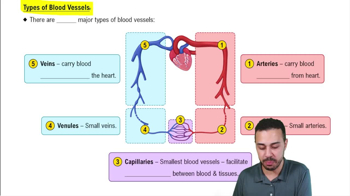
Types of Blood Vessels

Arteries and Veins

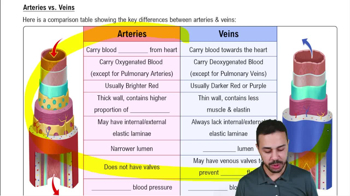
Arteries are blood vessels that carry blood away from the heart, usually containing oxygenated blood, while veins are vessels that return blood to the heart, typically carrying deoxygenated blood. The structure of arteries is thicker and more muscular to withstand high pressure, whereas veins have thinner walls and often contain valves to prevent backflow of blood.
Recommended video:
7:42
Arteries vs. Veins

Circulatory System

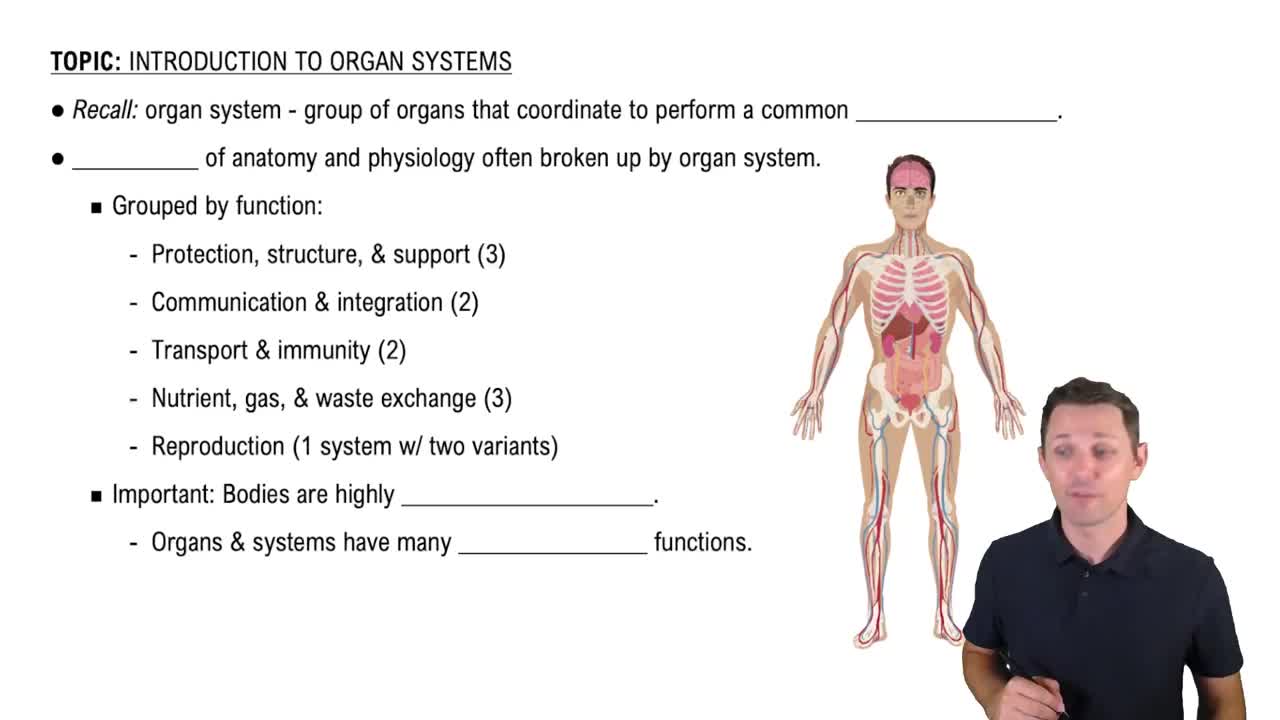
The circulatory system is responsible for the transport of blood, nutrients, gases, and waste products throughout the body. It consists of the heart, blood vessels (arteries, veins, and capillaries), and blood. Understanding the roles of arteries and veins within this system is crucial for comprehending how oxygen and carbon dioxide are exchanged in the body.
Recommended video:
Guided course
02:29
Introduction to Organ Systems