Ch. 20 The Lymphatic System and Immunity
Amerman - Human Anatomy & Physiology 2nd Edition
Amerman2nd EditionHuman Anatomy & PhysiologyISBN: 9780136873822Not the one you use?Change textbook
Chapter 20, Problem 7e

Mark the following statements as true or false. If a statement is false, correct it to make a true statement.
Fever is generated by pyrogens that reset the temperature set point of the hypothalamus to a lower value.

Verified step by step guidance
1
Step 1: Understand the role of pyrogens in fever generation. Pyrogens are substances, often produced by pathogens or immune cells, that influence the hypothalamus to increase the body's temperature set point, not lower it.
Step 2: Recall the function of the hypothalamus in thermoregulation. The hypothalamus acts as the body's thermostat, regulating temperature by adjusting physiological responses such as shivering or sweating.
Step 3: Identify the error in the statement. The statement incorrectly claims that pyrogens reset the temperature set point of the hypothalamus to a lower value, whereas they actually raise the set point to induce fever.
Step 4: Correct the false statement. The corrected version should read: 'Fever is generated by pyrogens that reset the temperature set point of the hypothalamus to a higher value.'
Step 5: Review the corrected statement to ensure it aligns with the physiological mechanism of fever generation and the role of pyrogens.

Verified video answer for a similar problem:

This video solution was recommended by our tutors as helpful for the problem above.
Was this helpful?

Key Concepts

Here are the essential concepts you must grasp in order to answer the question correctly.

Fever and Pyrogens

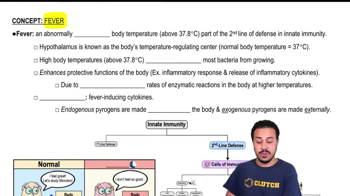
Fever is a physiological response characterized by an increase in body temperature, often due to infection or inflammation. Pyrogens are substances, either internal (endogenous) or external (exogenous), that induce fever by triggering the hypothalamus to raise the body's temperature set point.
Recommended video:
3:57
Fever

Hypothalamus Function

The hypothalamus is a critical brain region that regulates various bodily functions, including temperature control. It acts as the body's thermostat, responding to pyrogens by adjusting the set point for body temperature, leading to fever when the set point is elevated, not lowered.
Recommended video:
Guided course
6:11
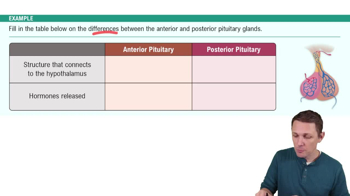
The Hypothalamus and Pituitary Gland Example 3

Correcting False Statements

In evaluating statements for truthfulness, it is essential to identify inaccuracies and provide corrections. In this case, the false statement can be corrected by stating that fever is generated by pyrogens that reset the temperature set point of the hypothalamus to a higher value, not a lower one.
Recommended video:
1:46
Structural Class: Synovial Joints Example 3