Ch. 17 The Cardiovascular System I: The Heart
Amerman - Human Anatomy & Physiology 2nd Edition
Amerman2nd EditionHuman Anatomy & PhysiologyISBN: 9780136873822Not the one you use?Change textbook
Chapter 17, Problem 13a

Mark the following statements as true or false. If a statement is false, correct it to make a true statement.
Systole is the contraction portion of the cardiac cycle and diastole is the relaxation portion.

Verified step by step guidance
1
Step 1: Understand the terms 'systole' and 'diastole' in the context of the cardiac cycle. Systole refers to the contraction phase of the heart, during which blood is ejected from the chambers (ventricles) into the arteries. Diastole refers to the relaxation phase, during which the heart chambers fill with blood.
Step 2: Analyze the given statement: 'Systole is the contraction portion of the cardiac cycle and diastole is the relaxation portion.' Compare this statement with the definitions of systole and diastole provided in Step 1.
Step 3: Determine whether the statement is true or false based on the definitions. If the statement aligns with the definitions, it is true. If it does not align, it is false.
Step 4: If the statement is false, correct it to make it true. For example, if the statement incorrectly defines systole or diastole, rewrite the statement with the accurate definitions.
Step 5: Review the corrected statement (if applicable) and ensure it accurately reflects the physiological processes of systole and diastole in the cardiac cycle.

Verified video answer for a similar problem:

This video solution was recommended by our tutors as helpful for the problem above.
Was this helpful?

Key Concepts

Here are the essential concepts you must grasp in order to answer the question correctly.

Cardiac Cycle

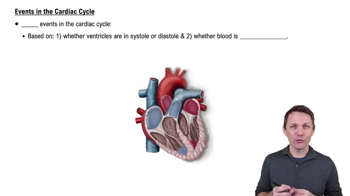
The cardiac cycle refers to the sequence of events that occur during one heartbeat, encompassing both contraction (systole) and relaxation (diastole) phases. Understanding this cycle is crucial for grasping how the heart functions to pump blood throughout the body.
Recommended video:
Guided course
9:44
Events in the Cardiac Cycle

Systole

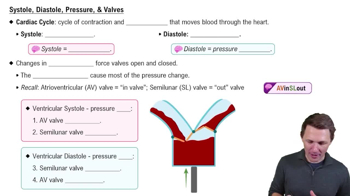
Systole is the phase of the cardiac cycle where the heart muscles contract, leading to the ejection of blood from the heart into the arteries. This phase is essential for maintaining blood circulation and ensuring that oxygenated blood reaches various tissues.
Recommended video:
Guided course
7:13
Systole, Diastole, Pressure, & Valves

Diastole

Diastole is the phase of the cardiac cycle that follows systole, during which the heart muscles relax and the chambers of the heart fill with blood. This phase is vital for preparing the heart for the next contraction and ensuring adequate blood supply to the heart and body.
Recommended video:
Guided course
7:13
Systole, Diastole, Pressure, & Valves