Ch. 14 The Autonomous Nervous System and Homeostasis
Amerman - Human Anatomy & Physiology 2nd Edition
Amerman2nd EditionHuman Anatomy & PhysiologyISBN: 9780136873822Not the one you use?Change textbook
Chapter 14, Problem 9d

Mark the following statements as true or false. If a statement is false, correct it to make a true statement.
d. Sympathetic tone controls the resting rate of the heart.

Verified step by step guidance
1
Step 1: Begin by understanding the concept of 'sympathetic tone' and its role in the autonomic nervous system. Sympathetic tone refers to the baseline level of activity in the sympathetic division of the autonomic nervous system, which is responsible for the 'fight or flight' response.
Step 2: Recall the role of the parasympathetic division in controlling the resting heart rate. The parasympathetic division, specifically through the vagus nerve, is primarily responsible for maintaining the resting heart rate by slowing it down.
Step 3: Compare the roles of the sympathetic and parasympathetic divisions. While the sympathetic division can increase heart rate during stress or activity, it does not control the resting heart rate under normal conditions.
Step 4: Evaluate the statement: 'Sympathetic tone controls the resting rate of the heart.' Based on the information above, this statement is false because the parasympathetic tone, not sympathetic tone, controls the resting heart rate.
Step 5: Correct the false statement to make it true: 'Parasympathetic tone controls the resting rate of the heart.'

Verified video answer for a similar problem:

This video solution was recommended by our tutors as helpful for the problem above.
Was this helpful?

Key Concepts

Here are the essential concepts you must grasp in order to answer the question correctly.

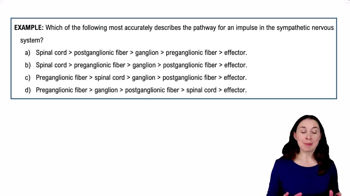
Sympathetic Nervous System

The sympathetic nervous system is part of the autonomic nervous system that prepares the body for 'fight or flight' responses. It increases heart rate, dilates airways, and redirects blood flow to muscles, among other functions. Understanding its role is crucial for evaluating statements about heart rate regulation.
Recommended video:
1:21
Sympathetic Nervous System Example 3

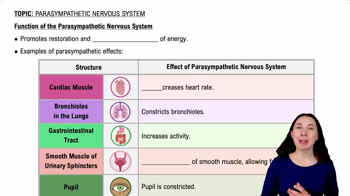
Parasympathetic Nervous System

The parasympathetic nervous system is the counterpart to the sympathetic system, responsible for 'rest and digest' activities. It decreases heart rate and promotes relaxation and recovery. This system primarily controls the resting heart rate, making it essential for correcting the false statement.
Recommended video:
1:56
Function of the Parasympathetic Nervous System

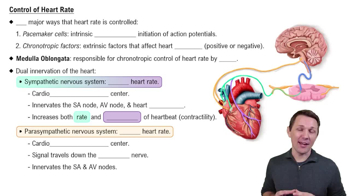
Heart Rate Regulation

Heart rate regulation involves the balance between the sympathetic and parasympathetic nervous systems. While the sympathetic system increases heart rate during stress, the parasympathetic system lowers it during restful states. Understanding this balance is key to accurately assessing statements about heart rate control.
Recommended video:
Guided course
6:13
Control of Heart Rate
Related Practice
Textbook Question

________ receptors are located on parasympathetic postganglionic neurons, and________ receptors are located on parasympathetic target cells.

655
views

Textbook Question

Match the following neurotransmitters with their correct description.    


_____ GABA    

_____ Dopamine     

_____ Substance P     

_____ Acetylcholine    

_____ Glutamate     

_____ Endorphins     

_____ Norepinephrine


a. Neuropeptide involved in transmission of pain

b. Neurotransmitter released at the neuromuscular junction

c. Major excitatory neurotransmitter in the brain

d. Major inhibitory neurotransmitter in the brain

e. Neuropeptide involved in relief of pain

f. Catecholamine involved in the autonomic nervous system

g. Catecholamine involved in movement and behavior

1233
views
Textbook Question

Mark the following statements as true or false. If a statement is false, correct it to make a true statement.

b. Sympathetic stimulation increases sweat secretion.

651
views
Textbook Question

Mark the following statements as true or false. If a statement is false, correct it to make a true statement.

a. The parasympathetic nervous system generally decreases the secretion from digestive glands.

739
views
Textbook Question

Mark the following statements as true or false. If a statement is false, correct it to make a true statement.

c. The parasympathetic nervous system releases acetylcholine onto all its synapses.

670
views
Textbook Question

Parasympathetic ganglia are typically:

a. Located along the spinal cord

b. Located near their target cells

c. Located within the central nervous system

d. Parasympathetic neurons do not synapse in ganglia

674
views