Ch. 13 The Peripheral Nervous System
Amerman - Human Anatomy & Physiology 2nd Edition
Amerman2nd EditionHuman Anatomy & PhysiologyISBN: 9780136873822Not the one you use?Change textbook
Chapter 13, Problem 1e

Mark the following statements as true or false. If a statement is false, correct it to make a true statement.
e. There are 31 pairs of spinal nerves and 12 pairs of cranial nerves.

Verified step by step guidance
1
Step 1: Understand the anatomy of the nervous system, specifically the division of spinal nerves and cranial nerves. Spinal nerves are part of the peripheral nervous system and emerge from the spinal cord, while cranial nerves emerge directly from the brain.
Step 2: Recall the number of spinal nerves. There are 31 pairs of spinal nerves in humans, categorized as cervical (8 pairs), thoracic (12 pairs), lumbar (5 pairs), sacral (5 pairs), and coccygeal (1 pair). This part of the statement is true.
Step 3: Recall the number of cranial nerves. There are 12 pairs of cranial nerves in humans, each with specific functions such as sensory, motor, or both. This part of the statement is also true.
Step 4: Evaluate the statement as a whole. Since both parts of the statement are accurate, the statement is true.
Step 5: If the statement were false, you would correct it by providing the accurate numbers for spinal nerves (31 pairs) and cranial nerves (12 pairs). However, no correction is needed in this case.

Verified video answer for a similar problem:

This video solution was recommended by our tutors as helpful for the problem above.
Was this helpful?

Key Concepts

Here are the essential concepts you must grasp in order to answer the question correctly.

Spinal Nerves

Spinal nerves are part of the peripheral nervous system and emerge from the spinal cord. There are 31 pairs of spinal nerves, which are categorized into cervical, thoracic, lumbar, sacral, and coccygeal regions. Each pair innervates specific body areas, facilitating communication between the central nervous system and the rest of the body.
Recommended video:
4:04
Splanchnic Nerves and the Adrenal Medulla

Cranial Nerves

Cranial nerves are a set of 12 pairs of nerves that emerge directly from the brain, primarily responsible for sensory and motor functions of the head and neck. They play crucial roles in functions such as vision, hearing, taste, and facial movements. Each cranial nerve has a specific function and pathway, contributing to the overall functioning of the nervous system.
Recommended video:
Guided course
8:20
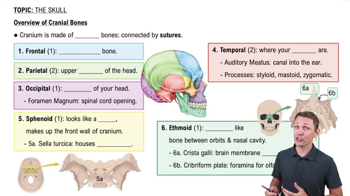
Overview of Cranial Bones

True/False Statements

True/false statements are assertions that can be evaluated for their accuracy. In the context of the question, understanding the correct number of spinal and cranial nerves is essential for determining the truth of the statement. If a statement is false, it can be corrected by providing the accurate information, which in this case involves recognizing that there are 12 pairs of cranial nerves, not 31.
Recommended video:
1:46
Structural Class: Synovial Joints Example 3