
Ch. 20 The Lymphatic System and Immunity
Amerman - Human Anatomy & Physiology 2nd Edition
Amerman2nd EditionHuman Anatomy & PhysiologyISBN: 9780136873822Not the one you use?Change textbook
Chapter 20, Problem 17e

Mark the following statements as true or false. If a statement is false, correct it to make a true statement.
Dendritic cells may activate both TH and TC cells.

Verified step by step guidance
1
Step 1: Understand the role of dendritic cells in the immune system. Dendritic cells are antigen-presenting cells (APCs) that play a crucial role in initiating the adaptive immune response by presenting antigens to T cells.
Step 2: Recall the types of T cells involved in the immune response. TH cells (helper T cells) assist other immune cells by releasing cytokines, while TC cells (cytotoxic T cells) directly attack infected or abnormal cells.
Step 3: Analyze the statement provided. Dendritic cells can activate TH cells by presenting antigens via MHC class II molecules, and they can activate TC cells by presenting antigens via MHC class I molecules.
Step 4: Determine whether the statement is true or false based on the above information. The statement 'Dendritic cells may activate both TH and TC cells' is true because dendritic cells interact with both types of T cells through different mechanisms.
Step 5: If the statement were false, correct it by explaining the specific mechanism of activation for each type of T cell. For example, 'Dendritic cells activate TH cells via MHC class II and TC cells via MHC class I molecules.'

Verified video answer for a similar problem:

This video solution was recommended by our tutors as helpful for the problem above.
Video duration:
6m
Was this helpful?

Key Concepts

Here are the essential concepts you must grasp in order to answer the question correctly.

Dendritic Cells

Dendritic cells are a type of antigen-presenting cell that play a crucial role in the immune system. They capture and process antigens, then present them on their surface to T cells, thereby initiating an adaptive immune response. Their ability to activate T cells is essential for the development of effective immunity against pathogens.
Recommended video:
02:10
The Epidermis: Cells Example 2

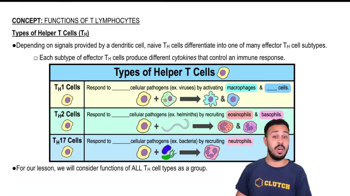
T Helper (T<sub>H</sub>) Cells

T Helper cells, or T<sub>H</sub> cells, are a subset of T cells that assist other immune cells by releasing cytokines. They are primarily involved in activating B cells and enhancing the activity of cytotoxic T cells and macrophages. T<sub>H</sub> cells are crucial for orchestrating the immune response and ensuring that the body can effectively combat infections.
Recommended video:
3:19
Types of Helper T Cells

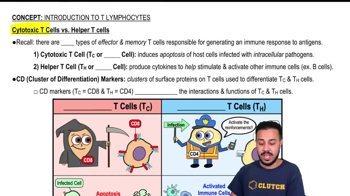
Cytotoxic T (T<sub>C</sub>) Cells

Cytotoxic T cells, or T<sub>C</sub> cells, are a type of T cell that directly kill infected or cancerous cells. They recognize specific antigens presented by infected cells and release perforin and granzymes to induce apoptosis in these target cells. T<sub>C</sub> cells are vital for controlling viral infections and eliminating tumor cells.
Recommended video:
5:58
Cytotoxic T Cells vs. Helper T Cells