Ch. 17 The Cardiovascular System I: The Heart
Amerman - Human Anatomy & Physiology 2nd Edition
Amerman2nd EditionHuman Anatomy & PhysiologyISBN: 9780136873822Not the one you use?Change textbook
Chapter 17, Problem 8d

Mark the following statements as true or false. If a statement is false, correct it to make a true statement.
The repolarization phase of the contractile cell is due to the potassium ions rushing into the cell through potassium ion channels.

Verified step by step guidance
1
Step 1: Understand the concept of repolarization in contractile cells. Repolarization refers to the process by which the cell's membrane potential returns to its resting state after depolarization. This is primarily driven by the movement of ions across the cell membrane.
Step 2: Recall the role of potassium ions during repolarization. During this phase, potassium ions move *out* of the cell through potassium ion channels, not *into* the cell. This outward movement of positively charged ions helps restore the negative resting membrane potential.
Step 3: Analyze the given statement. The statement claims that repolarization is due to potassium ions rushing *into* the cell, which contradicts the physiological process where potassium ions rush *out* of the cell.
Step 4: Correct the false statement. The accurate version of the statement should be: 'The repolarization phase of the contractile cell is due to the potassium ions rushing out of the cell through potassium ion channels.'
Step 5: Review the corrected statement and ensure it aligns with the physiological mechanisms of repolarization in contractile cells.

Verified video answer for a similar problem:

This video solution was recommended by our tutors as helpful for the problem above.
Was this helpful?

Key Concepts

Here are the essential concepts you must grasp in order to answer the question correctly.

Repolarization Phase

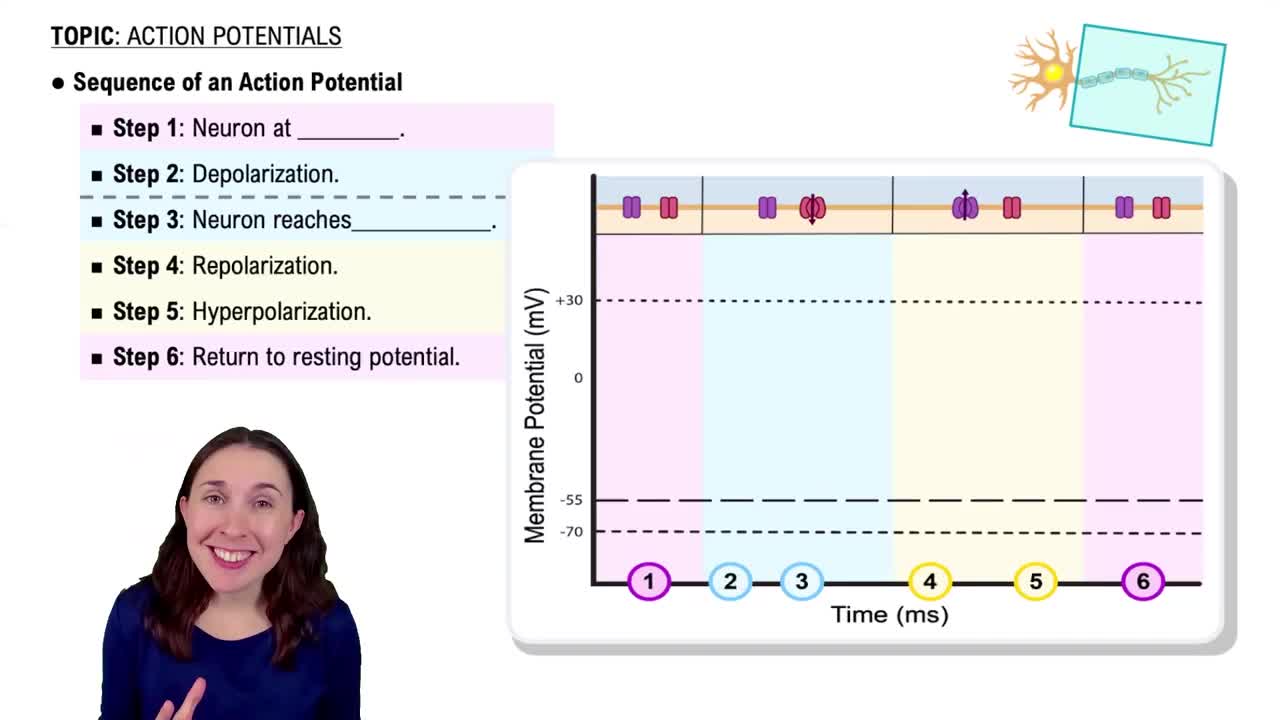
The repolarization phase in cardiac contractile cells refers to the process where the cell membrane potential returns to a more negative value after depolarization. This phase is primarily driven by the efflux of potassium ions (K+) out of the cell, which occurs through voltage-gated potassium channels. Understanding this phase is crucial for grasping how cardiac action potentials are generated and propagated.
Recommended video:
03:21
Phases of Mitosis

Ion Channels

Ion channels are specialized proteins that facilitate the movement of ions across cell membranes. In the context of cardiac cells, potassium ion channels play a vital role during the repolarization phase by allowing K+ ions to flow out of the cell, which helps restore the resting membrane potential. The proper functioning of these channels is essential for normal cardiac rhythm and function.
Recommended video:
01:55
Ions - Sodium and Potassium Example 3

Action Potential

An action potential is a rapid change in membrane potential that occurs in excitable cells, such as neurons and cardiac myocytes. It consists of several phases: depolarization, plateau, and repolarization. The understanding of action potentials is fundamental in physiology, as they are responsible for the contraction of heart muscles and the transmission of electrical signals throughout the heart.
Recommended video:
03:53
Action Potential