Ch. 1 Introduction to Anatomy and Physiology
Amerman - Human Anatomy & Physiology 2nd Edition
Amerman2nd EditionHuman Anatomy & PhysiologyISBN: 9780136873822Not the one you use?Change textbook
Chapter 1, Problem 16a

Mark the following statements as true or false. If a statement is false, correct it to make a true statement.
Structure and function are closely related at the organ level only.

Verified step by step guidance
1
Understand the statement: The statement claims that structure and function are closely related only at the organ level. This implies that the relationship between structure and function does not apply at other levels of organization, such as the cellular or tissue levels.
Recall the concept: In Anatomy & Physiology, structure and function are closely related at all levels of biological organization, from the molecular level to the organismal level. For example, the shape of a red blood cell (biconcave disc) is directly related to its function of transporting oxygen efficiently.
Evaluate the statement: Since the relationship between structure and function is not limited to the organ level, the statement is false.
Correct the statement: To make the statement true, it should be revised to say, 'Structure and function are closely related at all levels of biological organization.'
Summarize the correction: The corrected statement reflects the universal principle in Anatomy & Physiology that structure and function are interconnected across all levels, not just at the organ level.

Verified video answer for a similar problem:

This video solution was recommended by our tutors as helpful for the problem above.
Was this helpful?

Key Concepts

Here are the essential concepts you must grasp in order to answer the question correctly.

Structure and Function Relationship

The relationship between structure and function is a fundamental principle in biology, indicating that the form of a biological structure is closely related to its function. This concept applies not only at the organ level but also at the cellular and molecular levels, where the specific arrangement of components determines how they operate.
Recommended video:
06:04
Functional Groups

Levels of Biological Organization

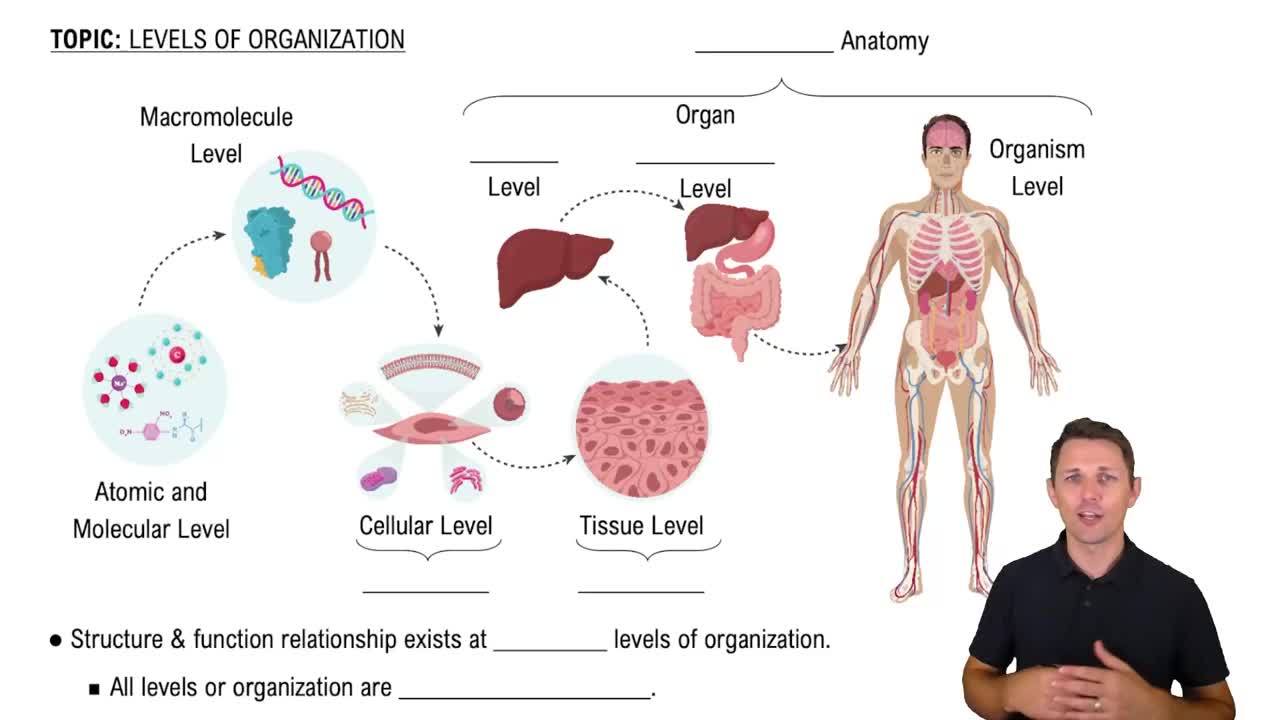
Biological organization is structured in levels, ranging from molecules and cells to tissues, organs, and systems. Each level has distinct characteristics and functions, and understanding how these levels interact is crucial for comprehending the overall functioning of an organism.
Recommended video:
Guided course
05:04
The Levels of Organization

True/False Statements in Scientific Context

In scientific discourse, true/false statements are often used to assess understanding of concepts. Correcting false statements requires not only identifying inaccuracies but also providing accurate information that reflects the underlying principles of biology, such as the interconnectedness of structure and function across various levels of organization.
Recommended video:
1:46
Structural Class: Synovial Joints Example 3