Ch. 25 The Urinary System
Marieb - Human Anatomy & Physiology 7th Edition
Marieb, Hoehn7th EditionHuman Anatomy & PhysiologyISBN: 9780805359091Not the one you use?Change textbook
Chapter 24, Problem 15

Explain how the peritubular capillaries are adapted for receiving reabsorbed substances.

Verified step by step guidance
1
Understand the role of peritubular capillaries: They surround the renal tubules and are responsible for absorbing substances that are reabsorbed from the filtrate back into the blood during urine formation.
Note the structural adaptations: Peritubular capillaries have a dense network of tiny blood vessels with a large surface area, which facilitates efficient exchange of substances between the tubules and the blood.
Consider the permeability of the capillaries: Their walls are thin and have fenestrations (small pores), allowing easy passage of water, ions, and small molecules from the tubules into the blood.
Recognize the low hydrostatic pressure in these capillaries: This low pressure favors the movement of reabsorbed substances from the interstitial fluid into the capillaries by bulk flow and diffusion.
Acknowledge the close proximity to the renal tubules: This close anatomical relationship minimizes the distance for diffusion, enhancing the efficiency of reabsorption of nutrients, ions, and water back into the bloodstream.

Verified video answer for a similar problem:

This video solution was recommended by our tutors as helpful for the problem above.
Video duration:
2m
Was this helpful?

Key Concepts

Here are the essential concepts you must grasp in order to answer the question correctly.

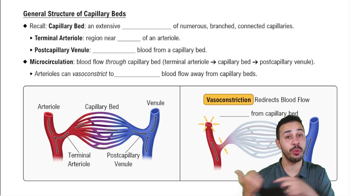
Structure of Peritubular Capillaries

Peritubular capillaries are small blood vessels surrounding the renal tubules with thin walls and a large surface area. Their porous endothelium allows easy exchange of substances, facilitating the uptake of reabsorbed molecules from the tubules back into the bloodstream.
Recommended video:
5:59
General Structure of Capillary Beds

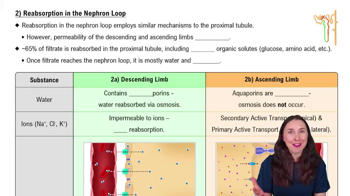
Function of Reabsorption in the Nephron

Reabsorption is the process by which essential substances like water, glucose, and ions are transferred from the filtrate in the renal tubules back into the blood. Peritubular capillaries play a key role by absorbing these substances, maintaining fluid and electrolyte balance.
Recommended video:
3:25
2) Reabsorption in the Nephron Loop

Pressure Dynamics Favoring Reabsorption

The low hydrostatic pressure and high osmotic pressure in peritubular capillaries create a favorable gradient for fluid and solutes to move from the tubules into the blood. This pressure difference enhances the efficient uptake of reabsorbed substances.
Recommended video:
Guided course
6:12
Partial Pressure