Ch. 25 The Urinary System
Marieb - Human Anatomy & Physiology 7th Edition
Marieb, Hoehn7th EditionHuman Anatomy & PhysiologyISBN: 9780805359091Not the one you use?Change textbook
Chapter 24, Problem 17

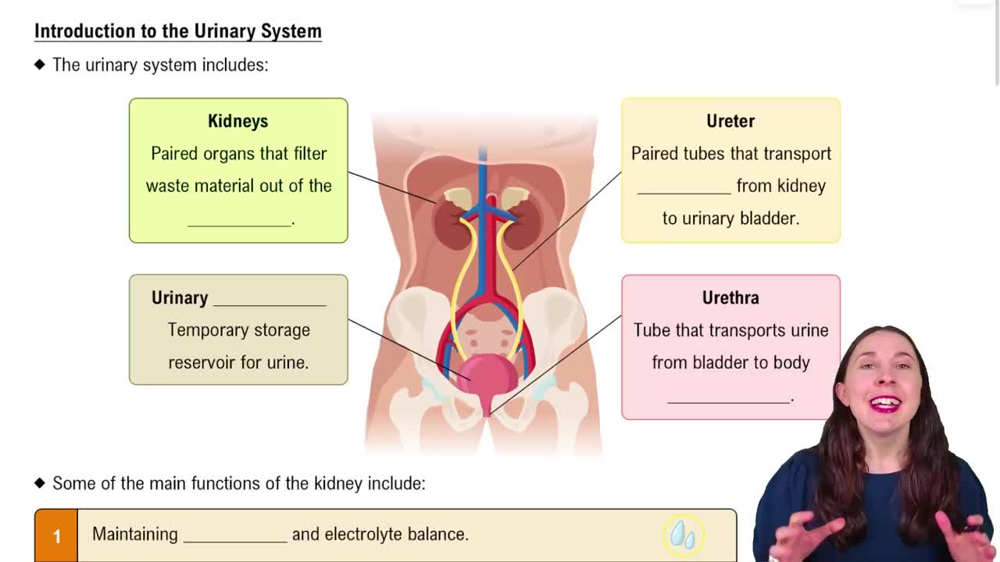
How does urinary bladder anatomy support its storage function?

Verified step by step guidance
1
Understand the primary function of the urinary bladder, which is to store urine temporarily before it is expelled from the body.
Examine the structure of the bladder wall, noting that it is composed of several layers including the mucosa, submucosa, muscularis (detrusor muscle), and adventitia or serosa.
Focus on the detrusor muscle, a layer of smooth muscle arranged in multiple directions, which allows the bladder to stretch and expand as it fills with urine without increasing internal pressure significantly.
Consider the transitional epithelium (urothelium) lining the bladder, which is specialized to stretch and provide a barrier to prevent urine from diffusing back into the surrounding tissues.
Recognize the presence of rugae (folds) in the mucosal layer when the bladder is empty, which flatten out as the bladder fills, allowing for increased volume without damage to the bladder wall.

Verified video answer for a similar problem:

This video solution was recommended by our tutors as helpful for the problem above.
Video duration:
2m
Was this helpful?

Key Concepts

Here are the essential concepts you must grasp in order to answer the question correctly.

Structure of the Urinary Bladder

The urinary bladder is a hollow, muscular organ with a flexible wall composed mainly of the detrusor muscle. Its expandable structure allows it to store varying volumes of urine without a significant increase in internal pressure, supporting its role as a reservoir.
Recommended video:
2:57
The Urinary System

Detrusor Muscle Function

The detrusor muscle is a smooth muscle layer that relaxes to accommodate urine storage and contracts during urination to expel urine. Its ability to stretch and contract is essential for maintaining bladder capacity and controlling urine release.
Recommended video:
06:04
Functional Groups

Bladder Neck and Sphincters

The bladder neck and internal and external urethral sphincters regulate urine flow. These sphincters maintain continence by keeping the bladder closed during storage and relaxing during voiding, ensuring controlled urine retention and release.
Recommended video:
Guided course
04:19
The Head and Neck