Besides acting as mechanical barriers, the skin epidermis and mucosae of the body have other attributes that contribute to their protective roles. Cite the common body locations and the importance of mucus, lysozyme, keratin, acid pH, and cilia.
Ch. 21 The Immune System: Innate and Adaptive Body Defenses

Marieb, Hoehn7th EditionHuman Anatomy & PhysiologyISBN: 9780805359091Not the one you use?Change textbook
All textbooks
Marieb, Hoehn 7th Edition
Ch. 21 The Immune System: Innate and Adaptive Body Defenses
Problem 16
Marieb, Hoehn 7th Edition
Ch. 21 The Immune System: Innate and Adaptive Body Defenses
Problem 16Chapter 20, Problem 16
Define immunocompetence and self-tolerance. How is self-tolerance achieved?
Verified step by step guidance1
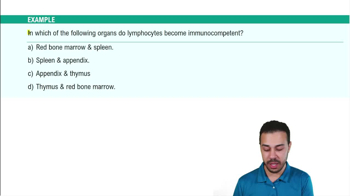
Define immunocompetence as the ability of immune cells, particularly lymphocytes, to recognize and respond specifically to antigens. It means these cells can identify foreign substances and mount an immune response.
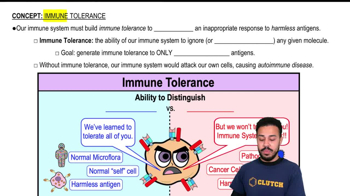
Define self-tolerance as the immune system's ability to recognize the body's own cells and molecules as 'self' and not attack them, preventing autoimmune reactions.
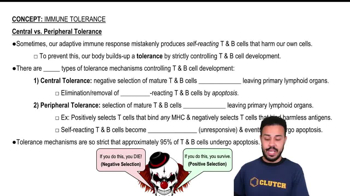
Explain that self-tolerance is primarily achieved through processes during lymphocyte development, where cells that strongly react to self-antigens are eliminated or inactivated.
Describe central tolerance, which occurs in primary lymphoid organs (thymus for T cells, bone marrow for B cells), where self-reactive lymphocytes undergo apoptosis or receptor editing.
Mention peripheral tolerance mechanisms that control any self-reactive lymphocytes that escape central tolerance, including anergy (functional inactivation), suppression by regulatory T cells, and deletion.

Verified video answer for a similar problem:
This video solution was recommended by our tutors as helpful for the problem above.
Video duration:
2mWas this helpful?
Key Concepts
Here are the essential concepts you must grasp in order to answer the question correctly.
Immunocompetence
Immunocompetence refers to the ability of the immune system, particularly lymphocytes, to recognize and respond effectively to specific antigens. It ensures that immune cells can identify pathogens and mount an appropriate defense, which is essential for protecting the body against infections.
Recommended video:
Overview of Lymphoid Organs Example 1
Self-tolerance
Self-tolerance is the immune system's capacity to avoid attacking the body's own cells and tissues. It prevents autoimmune reactions by ensuring that immune cells do not recognize self-antigens as threats, maintaining immune homeostasis and preventing damage to healthy tissues.
Recommended video:
Immune Tolerance
Mechanisms of Achieving Self-tolerance
Self-tolerance is achieved through central and peripheral mechanisms. Central tolerance occurs during lymphocyte development in the thymus and bone marrow, where self-reactive cells are eliminated or inactivated. Peripheral tolerance involves regulatory T cells and anergy to control any self-reactive cells that escape central tolerance.
Recommended video:
Central vs. Peripheral Tolerance
Related Practice
Textbook Question
977
views
Textbook Question
Differentiate between a primary and a secondary immune response. Which is more rapid and why?
1354
views
Textbook Question
Interferons are referred to as antiviral proteins. What stimulates their production, and how do they protect uninfected cells? Which cells of the body secrete interferons?
1238
views
Textbook Question
How do antibodies help defend the body?
1386
views
Textbook Question
What is complement? How does it cause bacterial lysis? What are some of the other roles of complement?
1433
views
Textbook Question
Define antibody. Using an appropriately labeled diagram, describe the structure of an antibody monomer. Indicate and label variable and constant regions, heavy and light chains.
1333
views