Ch. 11 Introduction to the Nervous System and Nervous Tissue
Amerman - Human Anatomy & Physiology 2nd Edition
Amerman2nd EditionHuman Anatomy & PhysiologyISBN: 9780136873822Not the one you use?Change textbook
Chapter 11, Problem 16c

Mark the following statements as true or false. If a statement if false, correct it to make a true statement.
An inhibitory postsynaptic potential causes the membrane potential of the postsynaptic neuron to approach threshold.

Verified step by step guidance
1
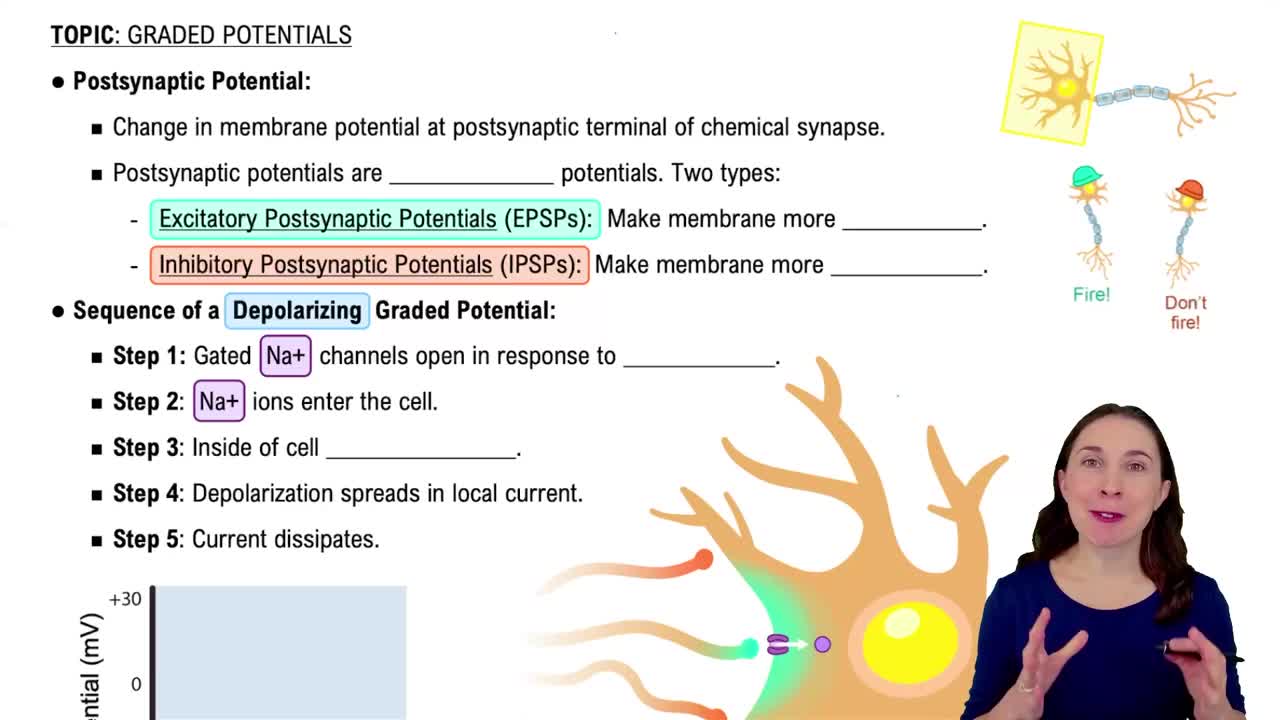
Understand the key terms in the statement: An inhibitory postsynaptic potential (IPSP) is a type of synaptic potential that makes a postsynaptic neuron less likely to generate an action potential. This occurs because the IPSP hyperpolarizes the membrane, moving it further away from the threshold.
Analyze the statement: 'An inhibitory postsynaptic potential causes the membrane potential of the postsynaptic neuron to approach threshold.' The term 'approach threshold' implies that the membrane potential is moving closer to the threshold for triggering an action potential.
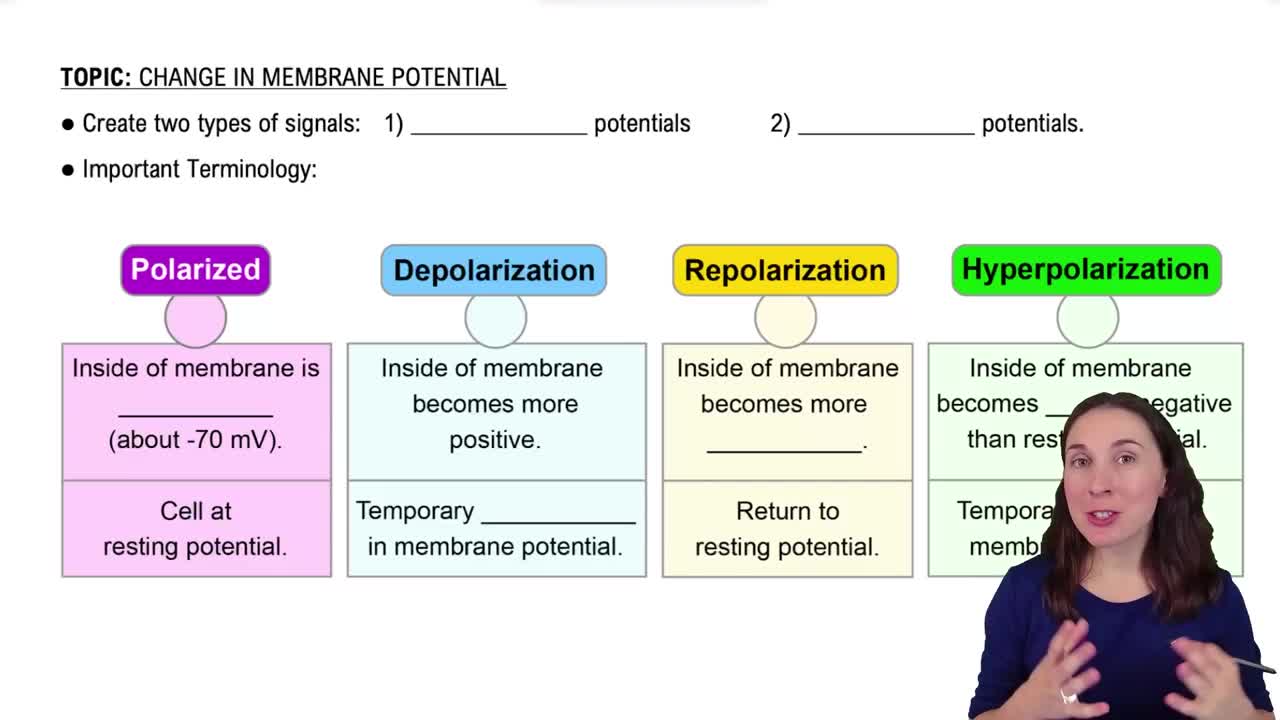
Compare the definition of IPSP with the statement: Since IPSPs hyperpolarize the membrane (make it more negative), they move the membrane potential further away from the threshold, not closer to it. This means the statement is false.
Correct the false statement: A corrected version of the statement would be, 'An inhibitory postsynaptic potential causes the membrane potential of the postsynaptic neuron to move further away from threshold.'
Summarize the reasoning: The key to solving this problem is understanding that IPSPs decrease the likelihood of an action potential by hyperpolarizing the membrane, which is the opposite of moving it closer to the threshold.

Verified video answer for a similar problem:

This video solution was recommended by our tutors as helpful for the problem above.
Was this helpful?

Key Concepts

Here are the essential concepts you must grasp in order to answer the question correctly.

Inhibitory Postsynaptic Potential (IPSP)

An inhibitory postsynaptic potential (IPSP) is a change in the postsynaptic membrane potential that makes it less likely to generate an action potential. This occurs when neurotransmitters bind to receptors that open ion channels, allowing negatively charged ions to enter the neuron or positively charged ions to exit, leading to hyperpolarization.
Recommended video:
05:55
Postsynaptic Potential

Membrane Potential

Membrane potential refers to the electrical potential difference across a cell's membrane, which is crucial for the function of neurons. It is determined by the distribution of ions inside and outside the cell, and changes in this potential can lead to the generation of action potentials, which are essential for neuronal communication.
Recommended video:
03:31
Change in Membrane Potential

Threshold Potential

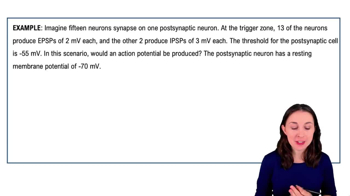
Threshold potential is the critical level to which a membrane potential must be depolarized to initiate an action potential. If the membrane potential reaches this threshold, voltage-gated sodium channels open, leading to a rapid influx of sodium ions and the subsequent firing of the neuron. IPSPs move the membrane potential away from this threshold, making it less likely for an action potential to occur.
Recommended video:
01:45
Graded Potentials Example 2