Ch. 7 The Skeletal System
Amerman - Human Anatomy & Physiology 2nd Edition
Amerman2nd EditionHuman Anatomy & PhysiologyISBN: 9780136873822Not the one you use?Change textbook
Chapter 7, Problem L2.1

Examine the structure of the skull, and predict its likely functions based on its form.

Verified step by step guidance
1
Examine the overall structure of the skull, noting its rigid and protective design made of multiple bones fused together. This structure provides a strong framework to protect vital organs such as the brain.
Identify specific features of the skull, such as the orbits (eye sockets), nasal cavity, and oral cavity. These openings allow for sensory functions like vision, smell, and taste, as well as respiration and communication.
Observe the presence of foramina (small holes) and canals in the skull, such as the foramen magnum and optic canal. These structures allow for the passage of nerves, blood vessels, and the spinal cord, facilitating communication between the brain and the rest of the body.
Analyze the jaw and teeth structure, noting how the mandible (lower jaw) and maxilla (upper jaw) are designed for chewing and processing food. The temporomandibular joint allows for movement, aiding in mastication and speech.
Consider the overall shape and contours of the skull, including the cranial vault and facial bones. These features provide attachment points for muscles, support facial expressions, and contribute to the skull's ability to absorb impact forces, protecting the brain and sensory organs.

Verified video answer for a similar problem:

This video solution was recommended by our tutors as helpful for the problem above.
Was this helpful?

Key Concepts

Here are the essential concepts you must grasp in order to answer the question correctly.

Skull Anatomy

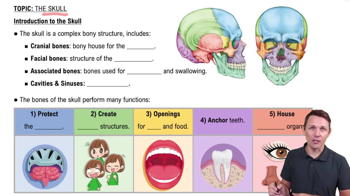
The skull is a complex structure composed of bones that protect the brain and support the facial features. It consists of two main parts: the cranium, which encases the brain, and the facial skeleton, which forms the structure of the face. Understanding the anatomy of the skull is essential for predicting its functions, as different shapes and features can indicate adaptations for various roles.
Recommended video:
Guided course
4:42
Introduction to the Skull

Functional Morphology

Functional morphology is the study of the relationship between the structure of an organism and its function. In the context of the skull, this concept helps in analyzing how specific features, such as the shape of the jaw or the size of the eye sockets, relate to dietary habits, sensory capabilities, and overall survival strategies. This understanding allows for predictions about how the skull's form influences its functional roles.
Recommended video:
06:04
Functional Groups

Evolutionary Adaptations

Evolutionary adaptations refer to the changes in an organism's structure or function that enhance its survival and reproduction in a specific environment. The skull has evolved in various species to accommodate different lifestyles, such as predation, herbivory, or social behavior. By examining the skull's structure, one can infer the evolutionary pressures that shaped its form and predict its functional implications.
Recommended video:
4:49
Adaptation