

Ch. 17 The Cardiovascular System I: The Heart
Amerman - Human Anatomy & Physiology 2nd Edition
Amerman2nd EditionHuman Anatomy & PhysiologyISBN: 9780136873822Not the one you use?Change textbook
Chapter 17, Problem 13c

Mark the following statements as true or false. If a statement is false, correct it to make a true statement.
The amount of blood in the ventricles at the end of the ventricular filling phase is the end-systolic volume.

Verified step by step guidance
1
Understand the key terms in the statement: 'ventricular filling phase' refers to the phase of the cardiac cycle when the ventricles are filling with blood, and 'end-systolic volume' refers to the amount of blood remaining in the ventricles after they have contracted (systole).
Identify the phase of the cardiac cycle being described: The ventricular filling phase occurs during diastole, when the ventricles are relaxed and filling with blood from the atria.
Compare the term 'end-systolic volume' with the phase described: End-systolic volume is associated with the end of systole, not diastole. The correct term for the amount of blood in the ventricles at the end of the ventricular filling phase is 'end-diastolic volume.'
Correct the false statement: The amount of blood in the ventricles at the end of the ventricular filling phase is the end-diastolic volume, not the end-systolic volume.
Mark the statement as false and provide the corrected version: 'False. The amount of blood in the ventricles at the end of the ventricular filling phase is the end-diastolic volume.'

Verified video answer for a similar problem:

This video solution was recommended by our tutors as helpful for the problem above.
Was this helpful?

Key Concepts

Here are the essential concepts you must grasp in order to answer the question correctly.

End-Systolic Volume (ESV)

End-systolic volume (ESV) refers to the volume of blood remaining in the ventricles at the end of contraction, or systole. It is a critical measurement in understanding cardiac function, as it reflects the heart's efficiency in pumping blood. ESV is typically lower than the end-diastolic volume, which is the volume of blood in the ventricles just before contraction.
Recommended video:
Guided course
6:28
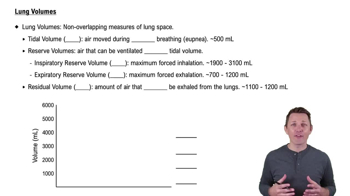
Lung Volumes

Ventricular Filling Phase

The ventricular filling phase occurs during diastole when the heart's ventricles fill with blood. This phase is crucial for ensuring that the heart has enough blood to pump out during the next contraction. The volume of blood in the ventricles at the end of this phase is known as the end-diastolic volume (EDV), which is distinct from ESV.
Recommended video:
03:21
Phases of Mitosis

Cardiac Cycle

The cardiac cycle encompasses all the events that occur during one heartbeat, including both systole and diastole. It involves the contraction and relaxation of the heart chambers, leading to the ejection of blood and subsequent filling. Understanding the phases of the cardiac cycle is essential for interpreting various cardiac volumes, such as ESV and EDV, and their implications for heart health.
Recommended video:
Guided course
9:44
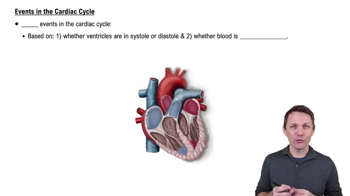
Events in the Cardiac Cycle