
Ch. 16 The Endocrine System
Amerman - Human Anatomy & Physiology 2nd Edition
Amerman2nd EditionHuman Anatomy & PhysiologyISBN: 9780136873822Not the one you use?Change textbook
Chapter 16, Problem 1a

Mark the following statements as true or false. If a statement is false, correct it to make a true statement.
The cells of the nervous system communicate via action potentials, whereas the cells of the endocrine system communicate via hormones.

Verified step by step guidance
1
Understand the key concepts: The nervous system communicates using electrical signals called action potentials, which travel along neurons. The endocrine system, on the other hand, communicates using chemical messengers called hormones, which are released into the bloodstream and act on target cells.
Analyze the statement: 'The cells of the nervous system communicate via action potentials, whereas the cells of the endocrine system communicate via hormones.'
Determine if the statement aligns with the definitions of the nervous and endocrine systems. In this case, the statement is accurate because it correctly describes the communication methods of both systems.
If the statement were false, identify the incorrect part and revise it. For example, if it incorrectly stated that the nervous system communicates via hormones, you would correct it to say 'The cells of the nervous system communicate via action potentials.'
Conclude that the statement is true as written, and no corrections are necessary.

Verified video answer for a similar problem:

This video solution was recommended by our tutors as helpful for the problem above.
Was this helpful?

Key Concepts

Here are the essential concepts you must grasp in order to answer the question correctly.

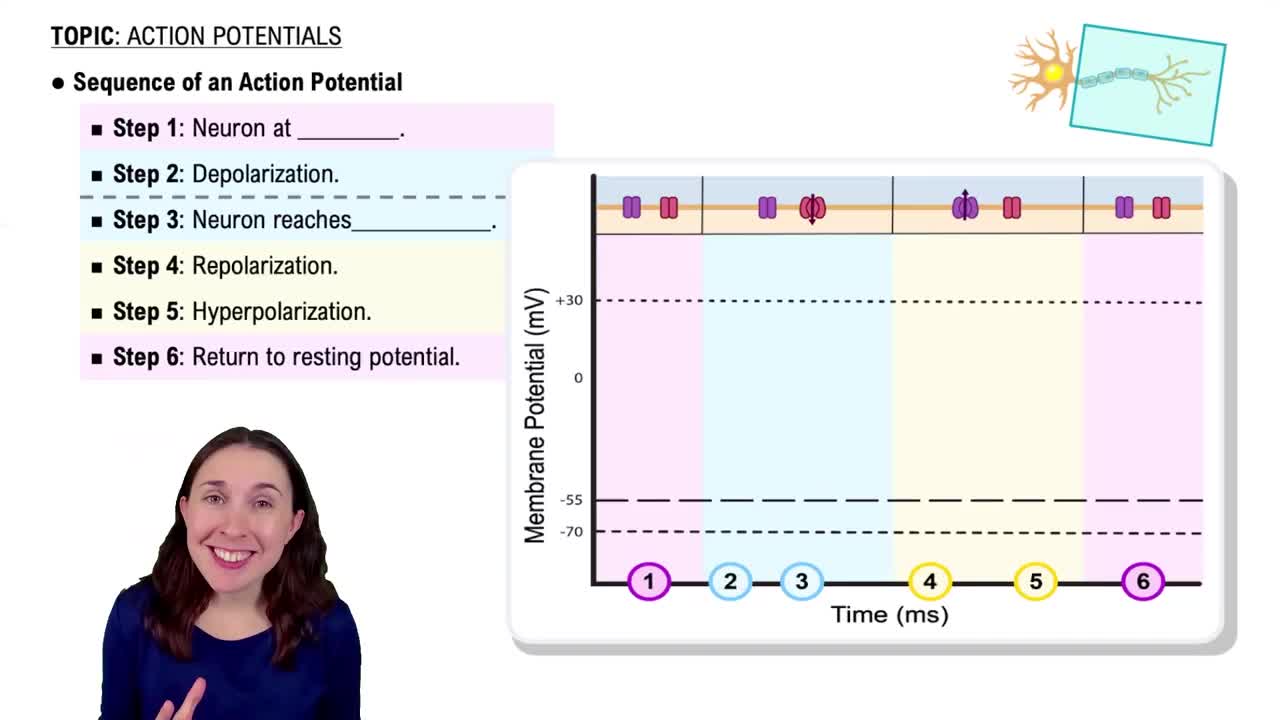
Action Potentials

Action potentials are rapid, temporary changes in the electrical membrane potential of a neuron that allow for the transmission of signals along the nerve cell. They are generated when a neuron reaches a certain threshold of depolarization, leading to the opening of voltage-gated ion channels. This process is crucial for communication within the nervous system, enabling the relay of information between neurons and to muscles.
Recommended video:
03:53
Action Potential

Hormonal Communication

Hormonal communication involves the release of hormones into the bloodstream by endocrine glands, which then travel to target organs or tissues to elicit specific physiological responses. This form of communication is slower than neural signaling but has longer-lasting effects, regulating processes such as growth, metabolism, and mood. Hormones act as chemical messengers, influencing various bodily functions over time.
Recommended video:
2:59
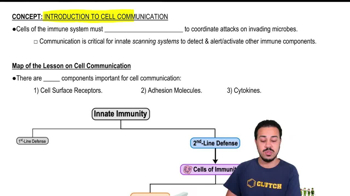
Map of the Lesson on Cell Communication

Nervous vs. Endocrine Systems

The nervous and endocrine systems are two primary communication networks in the body. The nervous system uses electrical impulses (action potentials) for rapid, short-term responses, while the endocrine system relies on chemical signals (hormones) for slower, long-term regulation. Understanding the distinct roles and mechanisms of these systems is essential for grasping how the body maintains homeostasis and responds to internal and external stimuli.
Recommended video:
Guided course
7:06
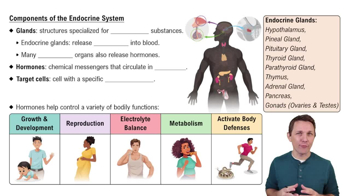
Components of the Endocrine System