Ch. 17 The Cardiovascular System I: The Heart
Amerman - Human Anatomy & Physiology 2nd Edition
Amerman2nd EditionHuman Anatomy & PhysiologyISBN: 9780136873822Not the one you use?Change textbook
Chapter 17, Problem 13b

Mark the following statements as true or false. If a statement is false, correct it to make a true statement.
Atrial systole is responsible for ejecting most of the blood into the ventricles during the ventricular filling phase of the cardiac cycle.

Verified step by step guidance
1
Step 1: Understand the cardiac cycle phases. The cardiac cycle consists of several phases, including ventricular filling, atrial systole, isovolumetric contraction, ventricular ejection, and isovolumetric relaxation. During ventricular filling, blood flows passively from the atria to the ventricles, primarily due to pressure differences.
Step 2: Analyze the role of atrial systole. Atrial systole refers to the contraction of the atria, which occurs at the end of the ventricular filling phase. This contraction pushes a small additional volume of blood (known as the atrial kick) into the ventricles, but most of the blood enters passively before atrial systole.
Step 3: Evaluate the statement. The statement claims that atrial systole is responsible for ejecting most of the blood into the ventricles during the ventricular filling phase. This is incorrect because most of the blood enters the ventricles passively due to pressure differences, not because of atrial systole.
Step 4: Correct the false statement. The corrected statement should read: 'Atrial systole is responsible for ejecting a small additional volume of blood into the ventricles during the ventricular filling phase of the cardiac cycle.'
Step 5: Summarize the key concept. Atrial systole contributes to ventricular filling but is not the primary mechanism for moving most of the blood into the ventricles; passive filling accounts for the majority of the blood transfer.

Verified video answer for a similar problem:

This video solution was recommended by our tutors as helpful for the problem above.
Was this helpful?

Key Concepts

Here are the essential concepts you must grasp in order to answer the question correctly.

Atrial Systole

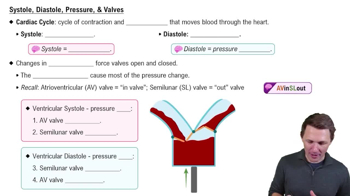
Atrial systole is the phase of the cardiac cycle where the atria contract, pushing blood into the ventricles. This phase occurs after the ventricles have filled with blood during diastole. While atrial systole contributes to ventricular filling, it is not responsible for ejecting most of the blood; rather, the majority of blood flows passively from the atria to the ventricles during diastole.
Recommended video:
Guided course
7:13
Systole, Diastole, Pressure, & Valves

Ventricular Filling Phase

The ventricular filling phase is a part of the cardiac cycle where the ventricles fill with blood. This phase consists of two parts: passive filling during diastole and active filling during atrial systole. Most of the blood enters the ventricles passively when the atrioventricular valves are open, and only a small amount is actively pushed in by atrial contraction.
Recommended video:
03:21
Phases of Mitosis

Cardiac Cycle

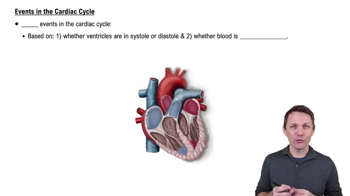
The cardiac cycle refers to the sequence of events that occur during one complete heartbeat, including contraction and relaxation of the heart chambers. It consists of two main phases: systole (contraction) and diastole (relaxation). Understanding the cardiac cycle is essential for comprehending how blood flows through the heart and the role of each phase in maintaining effective circulation.
Recommended video:
Guided course
9:44
Events in the Cardiac Cycle