
Ch. 9 The Muscular System
Amerman - Human Anatomy & Physiology 2nd Edition
Amerman2nd EditionHuman Anatomy & PhysiologyISBN: 9780136873822Not the one you use?Change textbook
Chapter 9, Problem 6a

Mark the following statements as true or false. If the statement is false, correct it to make a true statement.
The main action of the zygomaticus major and minor muscles is to pull the corners of the mouth up to produce smiling.

Verified step by step guidance
1
Step 1: Understand the function of the zygomaticus major and minor muscles. These muscles are located in the face and are primarily responsible for pulling the corners of the mouth upward and outward, which is associated with smiling.
Step 2: Evaluate the statement provided. The statement claims that the main action of the zygomaticus major and minor muscles is to pull the corners of the mouth up to produce smiling.
Step 3: Determine if the statement is true or false. Based on anatomical knowledge, the statement is true because the zygomaticus major and minor muscles are indeed responsible for this action.
Step 4: If the statement were false, you would need to correct it. For example, if the statement incorrectly attributed this action to another muscle, you would clarify that the zygomaticus major and minor are the correct muscles involved in smiling.
Step 5: Conclude that the statement is true and does not require correction, as it accurately describes the function of the zygomaticus major and minor muscles.

Verified video answer for a similar problem:

This video solution was recommended by our tutors as helpful for the problem above.
Was this helpful?

Key Concepts

Here are the essential concepts you must grasp in order to answer the question correctly.

Zygomaticus Major and Minor Muscles

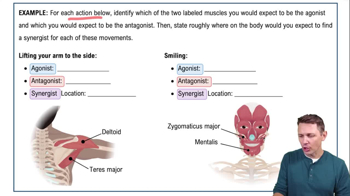
The zygomaticus major and minor are facial muscles located in the cheek area. The zygomaticus major is responsible for pulling the corners of the mouth upward, contributing to the expression of smiling. The zygomaticus minor assists in this action but also helps elevate the upper lip, enhancing facial expressions related to joy and happiness.
Recommended video:
Guided course
3:55
Muscle Actions Example 1

Facial Expressions

Facial expressions are the movements of facial muscles that convey emotions and reactions. They play a crucial role in non-verbal communication, allowing individuals to express feelings such as happiness, sadness, anger, and surprise. The zygomaticus muscles are integral to creating positive expressions, particularly smiling, which is universally recognized as a sign of happiness.
Recommended video:
Guided course
6:30
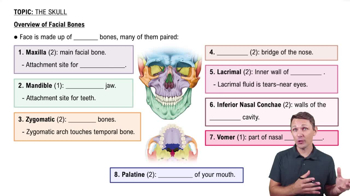
Overview of Facial Bones

True or False Statements

True or false statements are assertions that can be evaluated for their accuracy. In the context of the question, understanding whether the statement about the zygomaticus muscles is true or false requires knowledge of their anatomical function. If the statement is false, it is essential to identify the inaccuracy and provide a corrected version that accurately reflects the muscles' role in facial expressions.
Recommended video:
1:46
Structural Class: Synovial Joints Example 3