
Ch. 1 Introduction to Anatomy and Physiology
Amerman - Human Anatomy & Physiology 2nd Edition
Amerman2nd EditionHuman Anatomy & PhysiologyISBN: 9780136873822Not the one you use?Change textbook
Chapter 1, Problem 6d

Mark the following statements as true or false. If a statement is false, correct it to make a true statement.
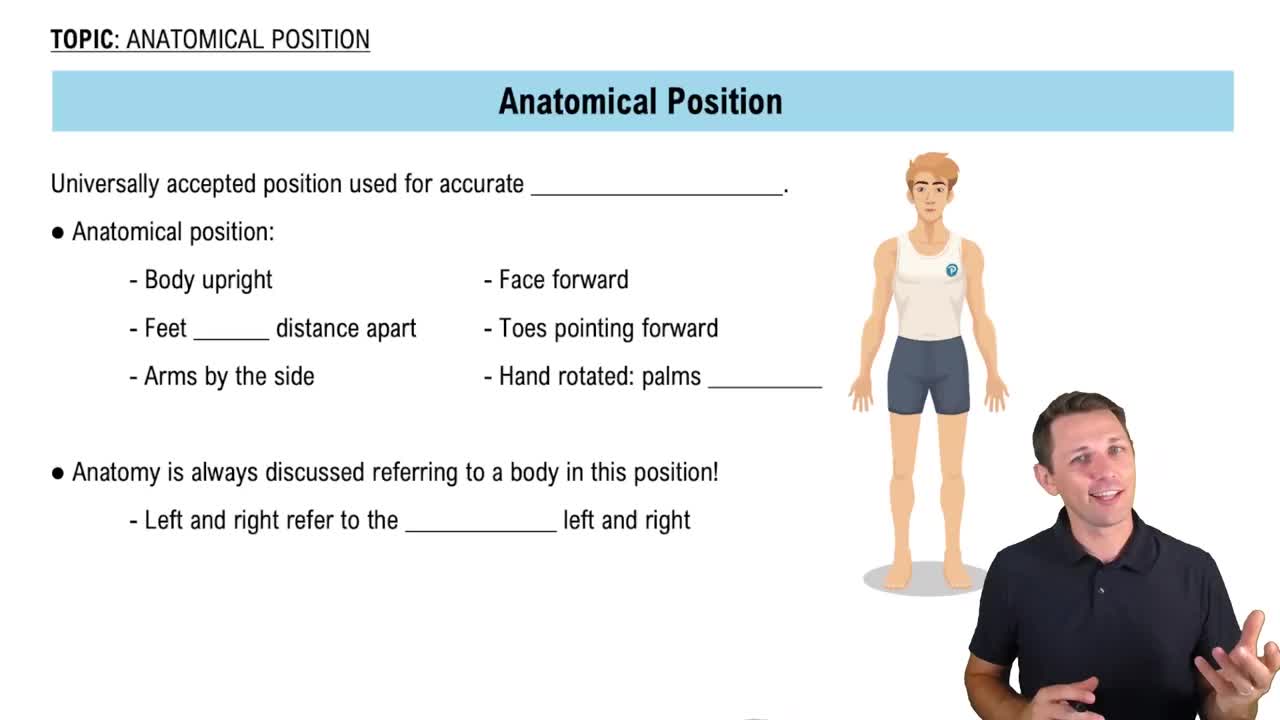
The anatomical position features the person facing forward, feet shoulder-width apart, and palms facing posteriorly.

Verified step by step guidance
1
Understand the definition of anatomical position: The anatomical position is a standard reference position in anatomy where the person is standing upright, facing forward, feet shoulder-width apart, arms at the sides, and palms facing anteriorly (forward).
Analyze the given statement: It claims that in the anatomical position, the palms are facing posteriorly (toward the back).
Compare the statement to the correct definition: The palms in the anatomical position should face anteriorly, not posteriorly.
Determine the truth value of the statement: The statement is false because it incorrectly describes the orientation of the palms.
Correct the false statement: The anatomical position features the person facing forward, feet shoulder-width apart, and palms facing anteriorly.

Verified video answer for a similar problem:

This video solution was recommended by our tutors as helpful for the problem above.
Was this helpful?

Key Concepts

Here are the essential concepts you must grasp in order to answer the question correctly.

Anatomical Position

The anatomical position is a standardized way of observing or imaging the body that allows for clear communication of anatomical structures. In this position, the individual stands upright, facing forward, with feet shoulder-width apart and arms at the sides, palms facing forward. This orientation serves as a reference point for anatomical terminology and descriptions.
Recommended video:
Guided course
02:40
Anatomical Position

Directional Terms

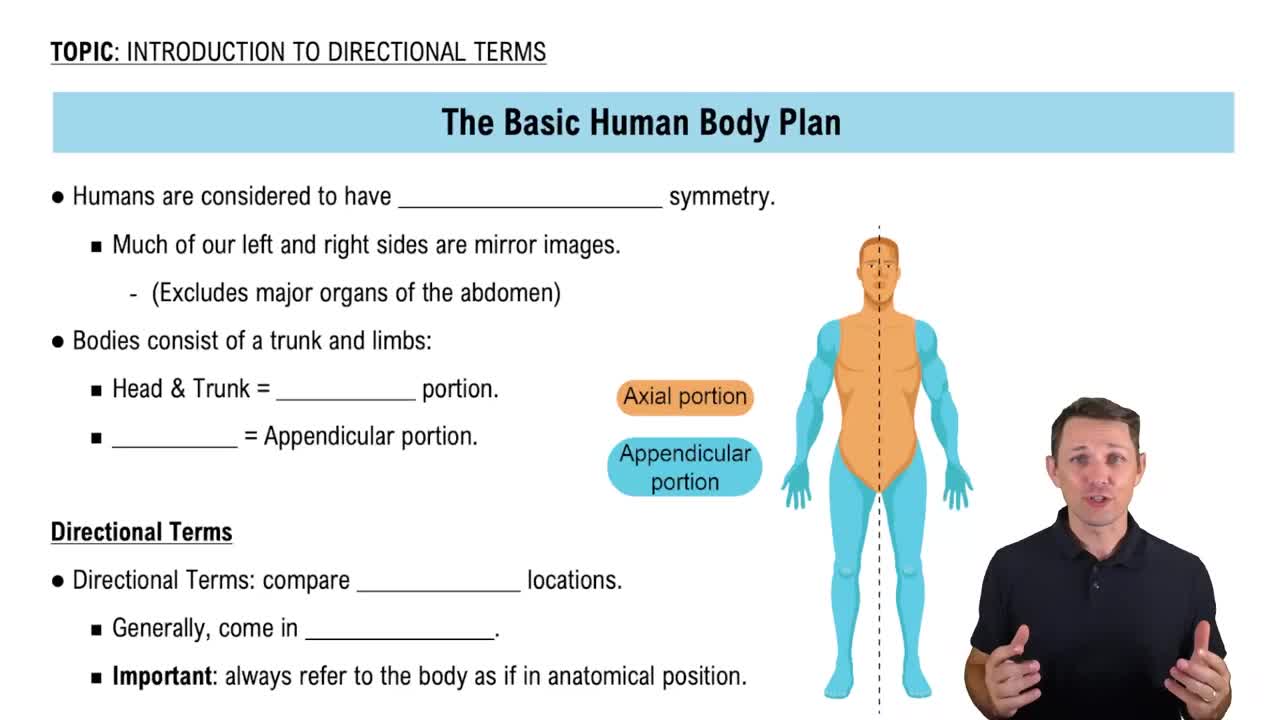
Directional terms are used in anatomy to describe the locations of structures in relation to other structures or locations in the body. Common terms include anterior (front), posterior (back), superior (above), and inferior (below). Understanding these terms is essential for accurately describing the anatomical position and the relationships between different body parts.
Recommended video:
Guided course
03:00
Introduction to Directional Terms

Body Planes

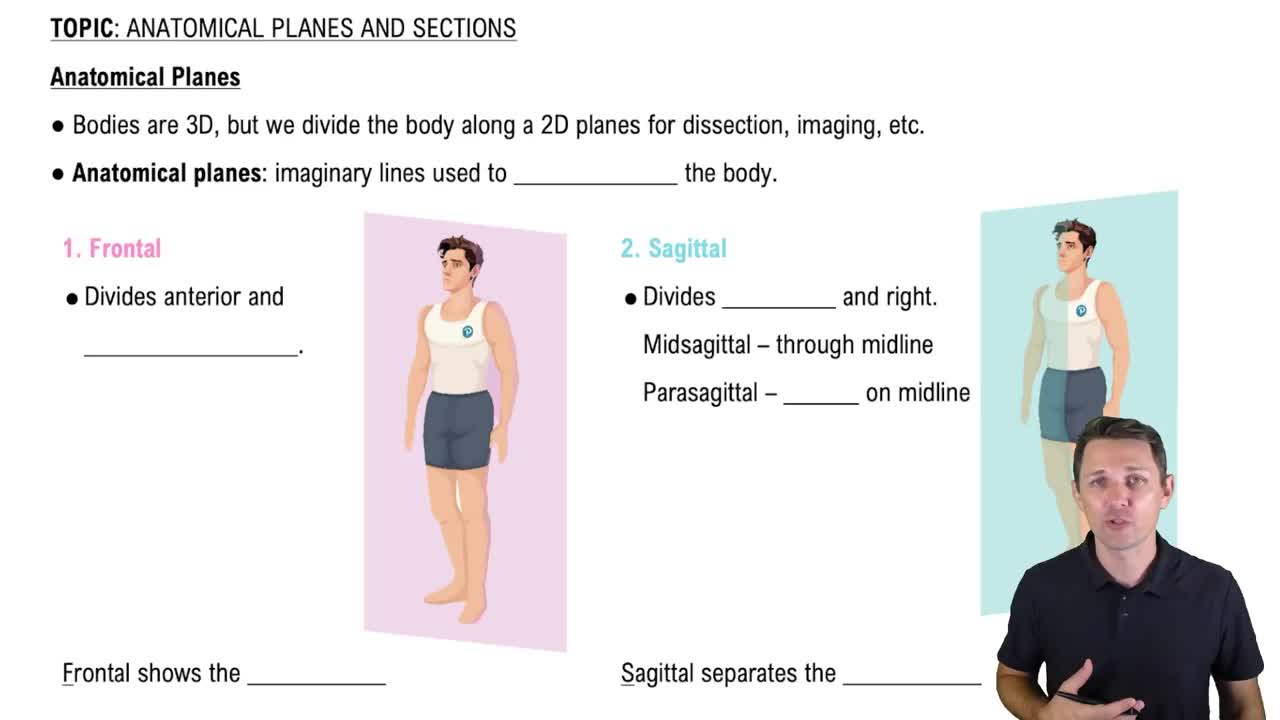
Body planes are imaginary lines that divide the body into sections, helping to describe locations and movements. The three primary planes are the sagittal plane (divides the body into left and right), the frontal (coronal) plane (divides the body into anterior and posterior), and the transverse plane (divides the body into superior and inferior). Knowledge of these planes is crucial for understanding anatomical relationships and movements.
Recommended video:
Guided course
04:01
Anatomical Planes
Related Practice
Textbook Question

Match the following terms with the correct definition.

Anterior: -----------a. Toward the back

Lateral:------------b. Closer to the midline      

Proximal: ----------c. Farther away from the point of origin      

Posterior:----------d. Toward the front    

Inferior:------------e. Closer to the point of origin

Distal:------------- f. Toward the head

Medial: -----------g. Away from the body's midline

Superior:----------- h. Toward the tail 

900
views
Textbook Question

Which of the following best describes the position of a tissue in the levels of organization of the human body?

a. Tissues are the most fundamental level of organization.

b. Tissues are between cells and organs in the levels of organization.

c. Tissues are the most complex level of organization.

d. Tissues are between organs and systems in the levels of organization.

1204
views
1
rank
Textbook Question

Mark the following statements as true or false. If a statement is false, correct it to make a true statement.

All living organisms are composed of one or more cells.

861
views
Textbook Question

The upper and lower limbs are known broadly as the________ region.

a. Appendicular

b. Axial

c. Crural

d. Dorsal

752
views
Textbook Question

Mark the following statements as true or false. If a statement is false, correct it to make a true statement.

Living organisms react to changes in their environment known as stimuli.

768
views
Textbook Question

Groups of many cells working together to perform a common function are known as a(n):

a. Cell

b. Organ

c. Organ system

d. Tissue

2959
views
1
rank