Ch. 7 The Skeletal System
Amerman - Human Anatomy & Physiology 2nd Edition
Amerman2nd EditionHuman Anatomy & PhysiologyISBN: 9780136873822Not the one you use?Change textbook
Chapter 7, Problem 4c

Mark the following statements as true or false. If a statement is false, correct it to make a true statement.


c. The sella turcica of the sphenoid bone houses the pituitary gland.

Verified step by step guidance
1
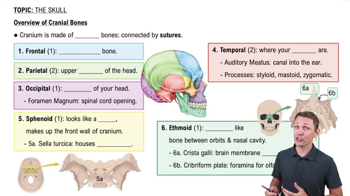
Step 1: Understand the anatomical structure mentioned in the statement. The sella turcica is a saddle-shaped depression located in the sphenoid bone of the skull. It is an important feature because it houses the pituitary gland.
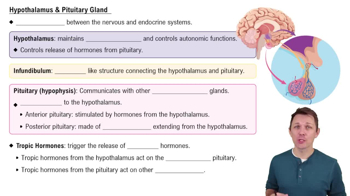
Step 2: Recall the function and location of the pituitary gland. The pituitary gland, often referred to as the 'master gland,' is located at the base of the brain and is protected within the sella turcica.
Step 3: Evaluate the statement provided. The statement claims that the sella turcica of the sphenoid bone houses the pituitary gland. Based on anatomical knowledge, this is correct.
Step 4: If the statement were false, identify the incorrect part and correct it. For example, if the statement incorrectly mentioned a different bone or structure, you would replace it with the correct anatomical term (e.g., 'The sella turcica of the sphenoid bone houses the pituitary gland' is correct, but 'The sella turcica of the temporal bone houses the pituitary gland' would be false).
Step 5: Confirm the accuracy of the statement and ensure the correction aligns with anatomical facts. In this case, the statement is true, and no correction is needed.

Verified video answer for a similar problem:

This video solution was recommended by our tutors as helpful for the problem above.
Was this helpful?

Key Concepts

Here are the essential concepts you must grasp in order to answer the question correctly.

Sella Turcica

The sella turcica is a saddle-shaped depression in the sphenoid bone of the skull. It is located at the base of the skull and serves as a protective cavity for the pituitary gland, which is crucial for regulating various hormonal functions in the body.
Recommended video:
Guided course
8:20
Overview of Cranial Bones

Pituitary Gland

The pituitary gland, often referred to as the 'master gland,' is an endocrine organ that produces and secretes hormones that regulate many bodily functions, including growth, metabolism, and reproduction. It is situated within the sella turcica, making this anatomical relationship significant for understanding its protection and function.
Recommended video:
Guided course
7:10
Hypothalamus & Pituitary Gland

Anatomical Relationships

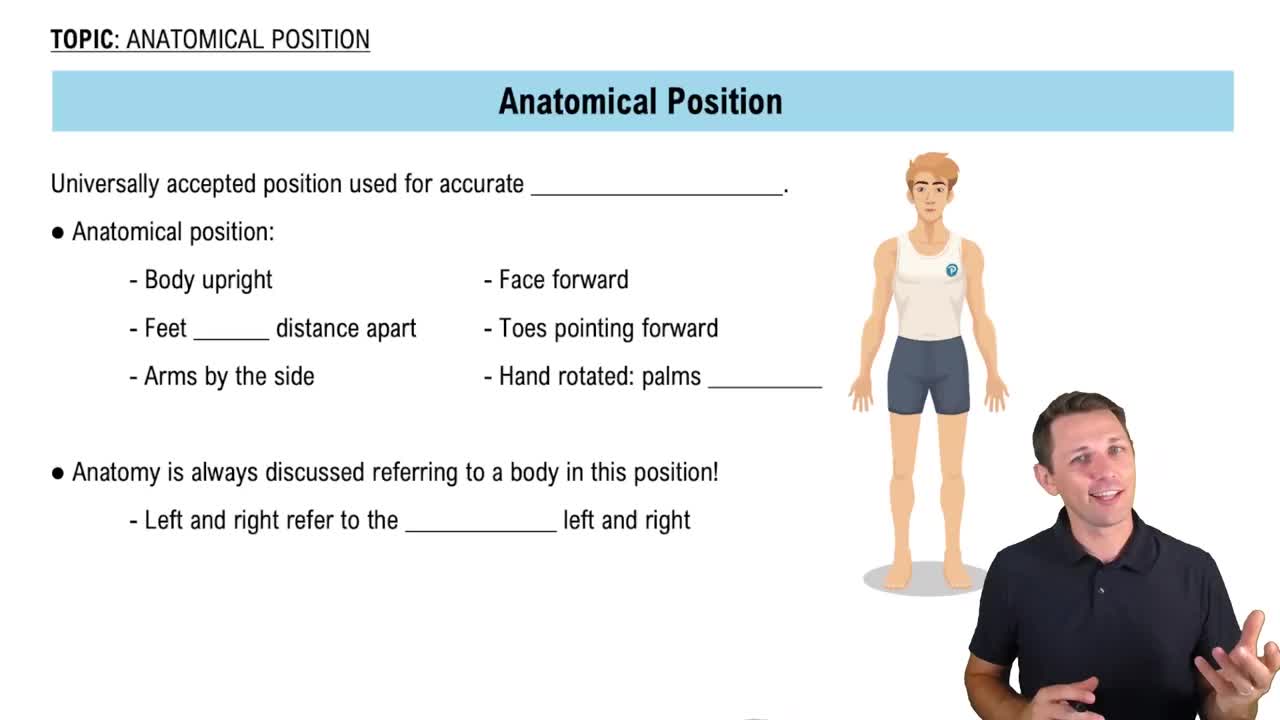
Anatomical relationships refer to the spatial and functional connections between different structures in the body. Understanding these relationships is essential for comprehending how organs interact and the implications of their locations, such as how the sella turcica's structure supports the pituitary gland's role in the endocrine system.
Recommended video:
Guided course
02:40
Anatomical Position