
Ch. 24 The Urinary System
Amerman - Human Anatomy & Physiology 2nd Edition
Amerman2nd EditionHuman Anatomy & PhysiologyISBN: 9780136873822Not the one you use?Change textbook
Chapter 24, Problem 7d

Mark the following statements as true or false. If a statement is false, correct it to make a true statement.
d. ADH triggers water reabsorption from the nephron loop.

Verified step by step guidance
1
Understand the role of ADH (antidiuretic hormone): ADH is a hormone that helps regulate water balance in the body by increasing water reabsorption in the kidneys. It acts specifically on the collecting ducts and distal tubules of the nephron, not the nephron loop.
Analyze the statement: The statement claims that ADH triggers water reabsorption from the nephron loop. This is incorrect because the nephron loop (loop of Henle) is primarily involved in concentrating urine through countercurrent mechanisms, and ADH does not act directly on this part of the nephron.
Correct the false statement: The correct version of the statement should be: 'ADH triggers water reabsorption from the collecting ducts and distal tubules of the nephron.'
Review the anatomy of the nephron: The nephron consists of several parts, including the glomerulus, proximal tubule, nephron loop (loop of Henle), distal tubule, and collecting duct. Each part has a specific function, and ADH primarily affects the distal tubule and collecting duct.
Conclude the correction: The original statement is false, and the corrected version clarifies the specific action of ADH in the nephron.

Verified video answer for a similar problem:

This video solution was recommended by our tutors as helpful for the problem above.
Was this helpful?

Key Concepts

Here are the essential concepts you must grasp in order to answer the question correctly.

Antidiuretic Hormone (ADH)

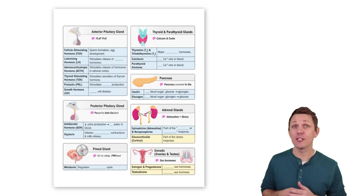
Antidiuretic Hormone (ADH), also known as vasopressin, is a hormone produced by the hypothalamus and released by the posterior pituitary gland. It plays a crucial role in regulating water balance in the body by promoting water reabsorption in the kidneys, specifically in the collecting ducts, rather than the nephron loop.
Recommended video:
Guided course
13:06
Review of Major Hormones

Nephron Structure and Function

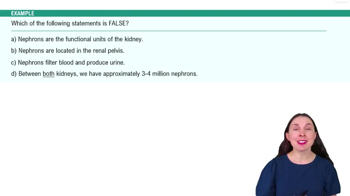
The nephron is the functional unit of the kidney, consisting of various segments including the glomerulus, proximal tubule, loop of Henle, distal tubule, and collecting duct. Each segment has specific roles in filtering blood, reabsorbing essential substances, and excreting waste, with ADH primarily affecting the collecting duct rather than the nephron loop.
Recommended video:
0:50
The Nephron Example 1

Water Reabsorption Mechanism

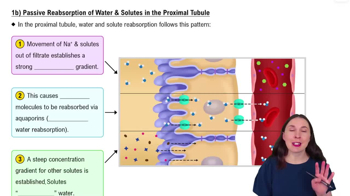
Water reabsorption in the kidneys occurs through osmosis, where water moves from the renal tubules back into the bloodstream. This process is influenced by hormones like ADH, which increases the permeability of the collecting ducts to water, allowing for greater reabsorption and concentration of urine, rather than occurring in the nephron loop.
Recommended video:
2:30
1b) Passive Reabsorption of Water & Solutes in the Proximal Tubule
Related Practice
Textbook Question

Which of the following is false about the GFR?

a. The GFR averages about 120 ml/min

b. The GFR increases when the afferent arteriole dilates

c. The GFR decreases when the efferent arteriole constricts

d. The GFR decreases when the afferent arteriole constricts

865
views
Textbook Question

Mark the following statements as true or false. If a statement is false, correct it to make a true statement.

e. Obligatory water reabsorption occurs in the distal tubule and collecting system.

819
views
1
rank
Textbook Question

Mark the following statements as true or false. If a statement is false, correct it to make a true statement.

b. The distal tubule reabsorbs sodium ions and secretes potassium and hydrogen ions in response to ADH.

671
views
Textbook Question

Mark the following statements as true or false. If a statement is false, correct it to make a true statement.

c. Sodium ion reabsorption creates a gradient that helps drive the reabsorption of water and many other solutes from the proximal tubule.

791
views
Textbook Question

Fill in the blanks for the following statements:

a. When the GFR decreases, the macula densa releases chemicals to______ the afferent arteriole.

b. The sympathetic nervous system______ the blood vessels supplying the kidney _____ to the glomerular filtration rate.

c. The enzyme _____ is released by JG cells in response to a decrease in the GFR.

d. The enzyme ______ converts angiotensin-I to angiotensin-II.

e. Generally, angiotensin-II______ systemic blood pressure while _____ the GFR.

797
views
1
rank
Textbook Question

Mark the following statements as true or false. If a statement is false, correct it to make a true statement.

a. Sodium ions and glucose are cotransported into the proximal tubule cell by secondary active transport.

669
views