Back
Back
Problem 1
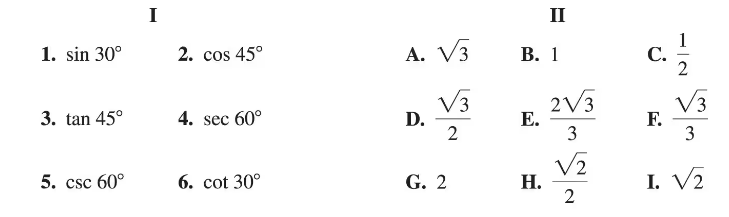
Match each trigonometric function in Column I with its value in Column II. Choices may be used once, more than once, or not at all.
sin 30°
Problem 3
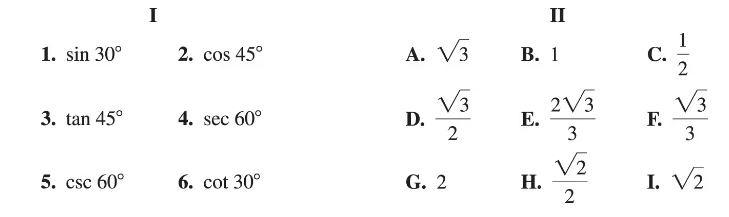
CONCEPT PREVIEW Match each trigonometric function in Column I with its value in Column II. Choices may be used once, more than once, or not at all.
tan 45°
Problem 5
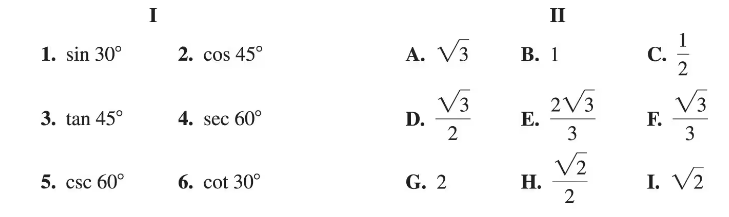
CONCEPT PREVIEW Match each trigonometric function in Column I with its value in Column II. Choices may be used once, more than once, or not at all.
csc 60°
Problem 6
Match each trigonometric function in Column I with its value in Column II. Choices may be used once, more than once, or not at all.
cot 30°
Problem 7
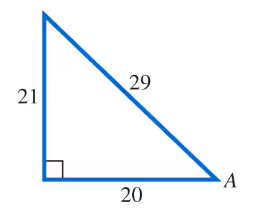
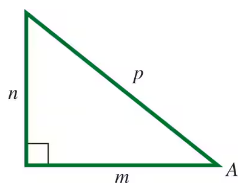
Find exact values or expressions for sin A, cos A, and tan A. See Example 1.
Problem 9
Find exact values or expressions for sin A, cos A, and tan A. See Example 1.
Problem 11
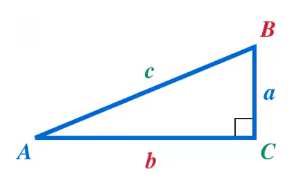
Suppose ABC is a right triangle with sides of lengths a, b, and c and right angle at C. Use the Pythagorean theorem to find the unknown side length. Then find exact values of the six trigonometric functions for angle B. Rationalize denominators when applicable. See Example 1.
a = 5, b = 12
Problem 13
Suppose ABC is a right triangle with sides of lengths a, b, and c and right angle at C. Use the Pythagorean theorem to find the unknown side length. Then find exact values of the six trigonometric functions for angle B. Rationalize denominators when applicable. See Example 1. a = 6, c = 7
Problem 16
Suppose ABC is a right triangle with sides of lengths a, b, and c and right angle at C. Use the Pythagorean theorem to find the unknown side length. Then find exact values of the six trigonometric functions for angle B. Rationalize denominators when applicable. See Example 1. b = 8, c = 11
Problem 18
Suppose ABC is a right triangle with sides of lengths a, b, and c and right angle at C. Use the Pythagorean theorem to find the unknown side length. Then find exact values of the six trigonometric functions for angle B. Rationalize denominators when applicable. See Example 1. a = √2, c = 2
Problem 22
Write each function in terms of its cofunction. Assume all angles involved are acute angles. See Example 2. sin 45°
Problem 26
Write each function in terms of its cofunction. Assume all angles involved are acute angles. See Example 2. tan 25.4°
Problem 28
Write each function in terms of its cofunction. Assume all angles involved are acute angles. See Example 2. cos(θ + 20°)
Problem 31
Find one solution for each equation. Assume all angles involved are acute angles. See Example 3. tan α = cot(α + 10°)
Problem 33
Find one solution for each equation. Assume all angles involved are acute angles. See Example 3. sin(2θ + 10°) = cos(3θ - 20°)
Problem 36
Find one solution for each equation. Assume all angles involved are acute angles. See Example 3. cot(5θ + 2°) = tan(2θ + 4°)
Problem 38
Find one solution for each equation. Assume all angles involved are acute angles. See Example 3. cos(2θ + 50°) = sin(2θ - 20°)
Problem 39
Find one solution for each equation. Assume all angles involved are acute angles. See Example 3. sec(3β + 10°) = csc(β + 8°)
Problem 40
Find one solution for each equation. Assume all angles involved are acute angles. See Example 3. csc(β + 40°) = sec(β - 20°)
Problem 42
Determine whether each statement is true or false. See Example 4. tan 28° ≤ tan 40°
Problem 44
Determine whether each statement is true or false. See Example 4. cos 28° < sin 28° (Hint: sin 28° = cos 62°)
Problem 46
Determine whether each statement is true or false. See Example 4. cot 30° < tan 40°
Problem 48
Determine whether each statement is true or false. See Example 4. csc 20° < csc 30°
Problem 49
Give the exact value of each expression. See Example 5. tan 30°
Problem 51
Give the exact value of each expression. See Example 5. sin 30°
Problem 52
Give the exact value of each expression. See Example 5. cos 30°
Problem 56
Give the exact value of each expression. See Example 5. sec 45°
Problem 58
Give the exact value of each expression. See Example 5. cot 45°
Problem 64
Give the exact value of each expression. See Example 5. csc 60°
Problem 67
Concept Check Work each problem. Find the equation of the line that passes through the origin and makes a 30° angle with the x-axis.