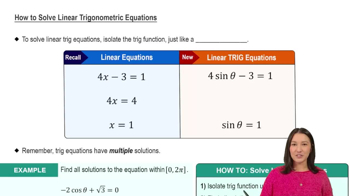
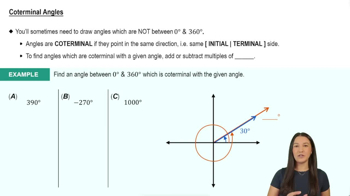
Find one solution for each equation. Assume all angles involved are acute angles. See Example 3. sec(3β + 10°) = csc(β + 8°)
Verified step by step guidance
1
Recall the definitions of the secant and cosecant functions in terms of sine and cosine: \(\sec \theta = \frac{1}{\cos \theta}\) and \(\csc \theta = \frac{1}{\sin \theta}\).
Rewrite the given equation \(\sec(3\beta + 10^\circ) = \csc(\beta + 8^\circ)\) using these definitions: \(\frac{1}{\cos(3\beta + 10^\circ)} = \frac{1}{\sin(\beta + 8^\circ)}\).
Cross-multiply to get an equation involving sine and cosine: \(\sin(\beta + 8^\circ) = \cos(3\beta + 10^\circ)\).
Use the co-function identity \(\cos \theta = \sin(90^\circ - \theta)\) to rewrite the right side: \(\sin(\beta + 8^\circ) = \sin(90^\circ - (3\beta + 10^\circ))\).
Simplify the right side inside the sine function and then solve the resulting equation \(\sin A = \sin B\) for \(\beta\), considering that \(\beta\) is an acute angle (between \(0^\circ\) and \(90^\circ\)). Remember that \(\sin A = \sin B\) implies \(A = B + 360^\circ k\) or \(A = 180^\circ - B + 360^\circ k\) for any integer \(k\).
Verified video answer for a similar problem:
This video solution was recommended by our tutors as helpful for the problem above
Play a video:
0 Comments
Key Concepts
Here are the essential concepts you must grasp in order to answer the question correctly.
Reciprocal Trigonometric Functions
Secant (sec) and cosecant (csc) are reciprocal functions of cosine and sine, respectively. Specifically, sec(θ) = 1/cos(θ) and csc(θ) = 1/sin(θ). Understanding these relationships allows rewriting the equation in terms of sine and cosine for easier manipulation.
Solving trigonometric equations involves isolating the trigonometric function and finding angle values that satisfy the equation within the given domain. Since the problem restricts angles to acute values, solutions must be between 0° and 90°, which limits possible solutions.
The equation involves expressions like 3β + 10° and β + 8°, which are linear combinations of the variable β. Understanding how to handle these composite angles is essential, as it requires applying algebraic techniques and possibly inverse trigonometric functions to isolate β.

 Verified step by step guidance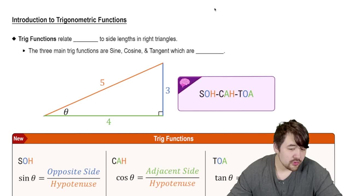
 6:04
6:04